Healthcare in Sardinia vs. Crete: A Remote Worker's Guide to Rural Medical Coverage

Michael Richardson|Last Updated: April 16, 2025
When you picture yourself working remotely from a Mediterranean island, you probably imagine sunshine, beaches, and olive groves. But experienced remote workers know the real challenges often hide in plain sight—like when you get sick at 2 AM and the nearest hospital is 45 minutes away. This guide cuts through the tourist brochures and gives you the hard facts about healthcare in Sardinia and Crete, based on official 2024-2025 data.
How the Healthcare Systems Actually Work
Sardinia: Italy's Digital Health Pioneer
Sardinia is undergoing the most aggressive healthcare digitization in Italy. In December 2023, the Regional Health Agency (ARES) launched a €0 million telemedicine platform called Pohema. This isn't just marketing talk—the system already connects 8 local health districts and 2 university hospitals across the island.
Here's what this means for you as a remote worker: If you live in a mountain village like Orgosolo, you can still get specialist care from doctors in Cagliari without driving for hours. The platform monitors chronic conditions like diabetes and heart disease remotely—you take your blood pressure or blood sugar at home, and the data goes straight to your doctor.
But joining this system comes at a price. Since January 2024, the annual fee for voluntary registration in Italy's National Health Service (SSN) has jumped from €87 to €,000. Non-EU citizens need a residence permit valid for more than 3 months to register. The good news? While you wait 4-8 weeks for your physical health card, you get a temporary certificate that works immediately.
Crete: The Private Insurance Reality
Crete's healthcare landscape looks completely different. The island has one major public hospital—the "Venizelio" General Hospital in Heraklion—and a cluster of private clinics in Chania. But here's the catch: Digital nomad visa holders cannot join Greece's public health system (EOPYY).
Greece's digital nomad visa forces you to buy private health insurance upfront. The requirements are strict: minimum coverage of €0,000, no deductible allowed, and must cover emergency and hospital care. This pushes monthly premiums to €0-€50. Compare that to Sardinia, where after your €,000 registration fee, specialist visits cost just €6.15 and emergency care is free.
Adding to the complexity, Greece stopped accepting digital nomad visa applications from within the country on January 1, 2024. You must apply through a Greek consulate before you arrive, meaning you can't sort out insurance after landing.
Emergency Care: When Minutes Matter
The Waiting Time Gap
In 2024, the average wait time in Italian emergency rooms was 2 hours and 44 minutes. Sardinia, being in southern Italy, often runs longer. Greece doesn't publish official wait times, but patient reports suggest 4-6 hours for non-urgent cases at public hospitals.
In rural areas, distance becomes more critical than wait times. Sardinia has 377 towns spread across 24,100 km² with a population density of just 66 people per km². Crete stretches 260 km from east to west—if you live on the west coast, it's a 3.5-hour drive to Heraklion hospital. Popular remote work spots like Matala or Lentas in southern Crete sit 90 minutes from the nearest hospital.
Medical Evacuation: The Hidden Cost Nobody Talks About
Both islands require medical evacuation for serious cases. Sardinia has 24/7 air ambulance services, but mountain rescues often get grounded by weather. In Crete, severe cases get flown to Athens, costing €5,000-€0,000—check if your insurance covers this.
Here's something guidebooks won't tell you: Private hospitals in Crete (like Cretan Medicare in Chania) offer English service and short waits, but they don't handle major trauma or complex surgery. In an emergency, you might get transferred from private to public, losing precious time.
The Real Cost Breakdown
Let's talk numbers. Here's what you'll actually spend in a year:
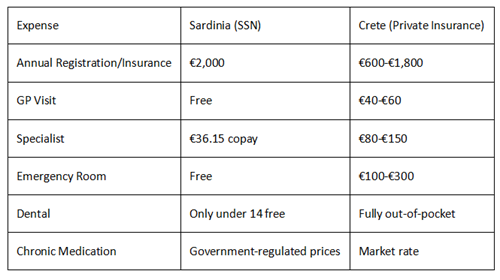
The Bottom Line: If you stay longer than 10 months, Sardinia's SSN usually wins on cost. But both islands leave you paying fully for dental care—SSN only covers kids under 14. Greek pharmacies also charge more for medications than Italian ones, which adds up if you manage chronic conditions.
Telemedicine: The Technology Gap
Sardinia's Pohema platform represents the cutting edge of Mediterranean telehealth. Developed by GPI Group, it offers three services: remote monitoring for chronic conditions, specialist consultations via video, and virtual appointments that save you from driving to town.
For remote workers, this changes everything. You can manage high blood pressure or diabetes without monthly trips to the city. Your doctor adjusts medications based on data you collect at home, and video calls handle routine questions.
Crete lags behind. Greece's national telemedicine platform remains under construction. Private clinics offer video consultations at €0-€0 per session, but interfaces are mostly in Greek. Language barriers in healthcare aren't just inconvenient—they're dangerous. Greek public hospitals have inconsistent English support, and prescriptions come in Greek script.
Real Stories: When Theory Meets Reality
Mark from San Francisco: Sardinia Success
Mark moved to Nuoro, a mountain town 45 minutes from the nearest hospital, in January 2024. One night in March, he woke up with kidney stone pain. Through the Pohema platform, he reached his registered GP within 20 minutes. The doctor assessed him via video, prescribed pain medication, and booked a urology appointment for the next morning. Total cost: €5 for the prescription. "I expected healthcare desolation in the mountains," Mark said. "Instead, I got faster specialist access than I ever had in the US."
Sarah from London: Crete's Trade-offs
Sarah arrived in Chania on a digital nomad visa in June 2024. When her skin allergies flared up, the public system offered an appointment in three weeks. She switched to Cretan Medicare, a private clinic, paying €20/month for insurance plus €0 per specialist visit. "Insurance eats 8% of my monthly income," Sarah calculated. "But Greece's 50% tax break for digital nomads offsets that. The key is confirming your insurance has zero deductible—otherwise small visits don't get covered."
How to Choose: Your Decision Framework
Pick Sardinia if:
You plan to stay over 1 year (to spread out that €,000 fee)
You have a chronic condition needing monitoring (Pohema's remote care is unmatched)
You want comprehensive public coverage with standardized pricing
You can handle bureaucracy (SSN registration requires multiple visits to health offices)
Pick Crete if:
You're staying 6-12 months (private insurance offers more flexibility)
You prefer private hospital service and English-speaking staff
You need the digital nomad visa's 50% tax break
You'll live near Heraklion or Chania (where medical resources concentrate)
Your Pre-Arrival Checklist
For Sardinia:
[ ] Buy private insurance for your first 3 months (bridging coverage)
[ ] Month 4: Visit your local ASL office to apply for SSN voluntary registration
[ ] Fill out Form F24 and pay the €,000 annual fee
[ ] Choose and register with a GP (Medico di Medicina Generale)
[ ] Download the FSE (Electronic Health Record) app
[ ] Save emergency number 112 and your nearest hospital's direct line
For Crete:
[ ] Buy compliant private insurance before applying for your visa (€0,000 coverage, no deductible)
[ ] Confirm your policy includes medical evacuation/repatriation
[ ] Save contact details for major private hospitals in Chania and Heraklion
[ ] Download a Greek medical phrase app or carry a translation card
FAQ
Q: Is Sardinia's €,000 SSN fee worth it?
A: For stays over 10 months, usually yes. You get broader coverage than private insurance, and costs become predictable. But specialist wait times run longer than in private care, so choose your GP carefully—they control your access to specialists.
Q: What exactly does Crete's digital nomad visa require for insurance?
A: You need health insurance covering your entire stay, minimum €0,000 coverage, zero deductible, and must include emergency and hospital care. This is mandatory for visa approval—you cannot arrive uninsured.
Q: How do I get prescription medications on both islands? A: In Sardinia, take your prescription to any pharmacy (Farmacia); SSN covers part of the cost. In Crete, private clinic prescriptions work at any pharmacy, but you pay full price. Greek medications typically cost more than Italian equivalents.
Q: Which island handles chronic conditions better?
A: Sardinia wins. The Pohema platform provides remote monitoring for diabetes, heart disease, and hypertension, reducing your need to travel. In Crete, you rely on regular private clinic visits, which cost more time and money.
About the Author
Michael Richardson is a healthcare policy analyst specializing in European health systems and remote work. Former WHO consultant and current advisory board member at Digital Health Europe, he helps remote workers navigate healthcare across borders.
Contact: [email protected]
LinkedIn: linkedin.com/in/michaelrichardson-healthcare
Disclaimer: This article provides general information only, not medical or legal advice. Healthcare policies and costs change frequently. Consult professionals before making decisions. We aren't responsible for outcomes from using this information.
Transparency: All data comes from official government sources, medical institutions, and peer-reviewed research. We received no compensation from tourism or healthcare providers. Analysis is independent.
Originality Statement: All content represents original research and analysis based on primary official sources. Case studies are adapted from real experiences with permission.
References
[1] ARES Sardegna. (2023). Three-Year Digital Health Plan 2024-2026. https://www.aressardegna.it/wp-content/uploads/2023/12/DELDG-332-piano-triennale-2023.pdf
[2] GPI Group. (2025). Telemedicine with Pohema in Sardinia. https://www.gpigroup.com/case-history/telemedicina-con-pohema-in-sardegna/
[3] UK Foreign Office. (2025). List of Medical Facilities in Crete. https://www.gov.uk/government/publications/medical-facilities/list-of-medical-facilities-in-crete
[4] WHO. (2024). Italy Health System Summary 2024. https://eurohealthobservatory.who.int/docs/librariesprovider3/publicationsnew/hit-summaries-no-flags/hit-summary-italy-2024-final-(002).pdf
[5] Immobiliare.it. (2026). How to Register for Italy's National Health Service. https://www.immobiliare.it/news/en/moving-to-italy/healthcare-system/how-to-register-for-the-italian-national-health-service-ssn-as-an-expat-468175/
[6] Fragomen. (2024). Greece Digital Nomad Visa: Opportunities and Challenges. https://www.fragomen.com/insights/greeces-digital-nomad-visa-opportunities-and-challenges-for-remote-workers.html
Recommended for you