Croatia vs Portugal Digital Nomad Visa: 0% tax exemption vs Permanent Resident Status. Which one should be chosen in 2026?

Author: Dr. Elena Vuković-Morrison|Last updated date: April 20, 2026
In April 2026, two distinct paths exist for remote workers seeking European rural bases. Croatia's Digital Nomad Visa allows you to retain 100% of foreign earnings tax-free—but requires departure after 36 months with no route to permanent residency. Portugal's D8 visa offers a 5-year pathway to permanent residency and eventual citizenship, yet most remote workers face combined tax and social security burdens of 40-50%.
This guide examines verified government data, court rulings, and infrastructure reports to clarify a decision that existing coverage often misrepresents. We correct critical inaccuracies—including the status of Portugal's nationality law reforms—and provide transparent sourcing for all comparative claims.
Part 1: Tax Reality Check—What You Actually Keep
Croatia: Verified Zero-Tax Structure
Croatia's Digital Nomad Visa (DNV) provides complete exemption from Croatian income tax on foreign-sourced remote work income under Article 4 of the Income Tax Act. This is not a reduced rate—it's a full exemption.
2026 Verified Tax Treatment:
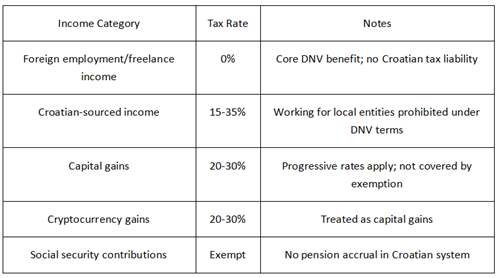
Critical Limitation: The exemption applies to income tax only. Health insurance (approximately €0-100/month private coverage) and potential US tax obligations remain. The social security exemption means no contributions toward Croatian pension benefits—a long-term trade-off for short-term savings.
Application: Croatian Ministry of Interior (MUP) Portal
Portugal: The IFICI Narrowing Effect
Portugal closed its Non-Habitual Resident (NHR) regime to new applicants on January 1, 2024, replacing it with the IFICI (Tax Incentive for Scientific Research and Innovation). The practical impact: most remote workers no longer qualify for meaningful tax reductions.
IFICI Eligibility (2026 Verified):
The regime applies only to narrowly defined categories :
Teaching and scientific research in higher education institutions
R&D staff at entities with SIFIDE tax incentives
Certified startup employees (Startup Visa program participants)
Specific "highly qualified activities" defined by ministerial order
Tax Reality for Non-Qualifying D8 Holders:
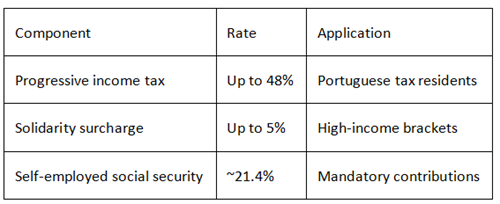
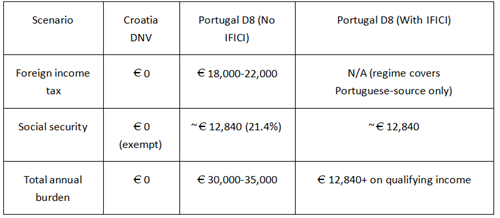
Combined effective rates for high-income remote workers frequently exceed 40%, significantly higher than under the previous NHR regime .
Annual Tax Comparison (€0,000 Foreign Income)
Part 2: Visa Structure—Temporary vs. Permanent Pathways
Croatia DNV: Extended but Still Terminal
2026 Updated Framework (March 2025 Amendments):
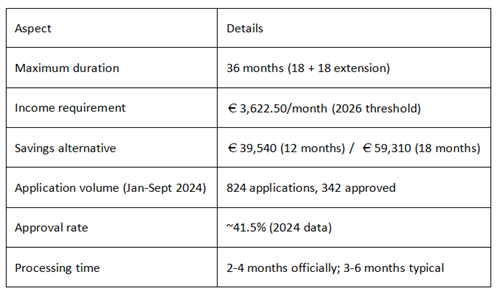
Structural Limitation: The DNV remains non-renewable in the traditional sense. After 36 months maximum, holders must depart Croatia for 6 months before reapplying. Crucially, DNV time does not count toward permanent residency or citizenship requirements. This is a fundamental distinction from Portugal's structure.
Portugal D8: The Residency Pathway
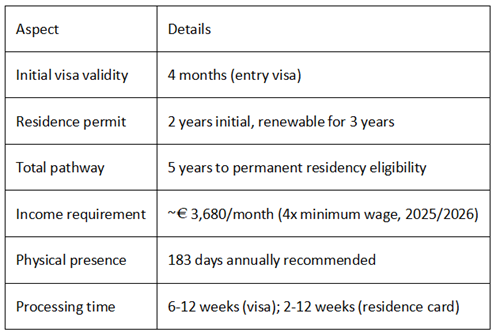
AspectDetailsInitial visa validity4 months (entry visa)Residence permit2 years initial, renewable for 3 yearsTotal pathway5 years to permanent residency eligibilityIncome requirement~€,680/month (4x minimum wage, 2025/2026)Physical presence183 days annually recommendedProcessing time6-12 weeks (visa); 2-12 weeks (residence card)
Citizenship Clarification (Critical Correction):
Contrary to claims in some 2026 coverage, Portugal's nationality law has NOT changed to 10 years. In December 2025, the Constitutional Court ruled that proposed amendments extending residency requirements from 5 to 10 years violated constitutional principles, including legitimate expectations and legal certainty . President Marcelo Rebelo de Sousa vetoed the legislation on December 19, 2025 .
Current Status: The existing 5-year naturalization requirement remains in force. Parliament may revisit amendments, but as of April 2026, no changes have taken effect .
Part 3: Rural Infrastructure—Connectivity Determines Viability
Portugal: Europe's Rural Fiber Leader
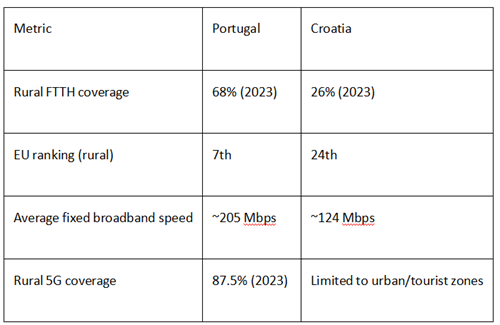
Portugal ranks 7th in the EU for rural fiber-to-the-home (FTTH) coverage, with 68% of rural households passed as of September 2023—up from just 15% in 2015 . This represents one of Europe's most aggressive rural broadband rollouts.
Verified Connectivity Data:
Concrete Rural Projects:
€25 million inland fiber project: Targeting 400,000+ households by 2026/2027
10 Gbps availability: MEO, NOS, Vodafone, and DIGI offer multi-gigabit rural plans
Regional coverage: Nine of 25 Portuguese regions achieve >95% very high-capacity network coverage
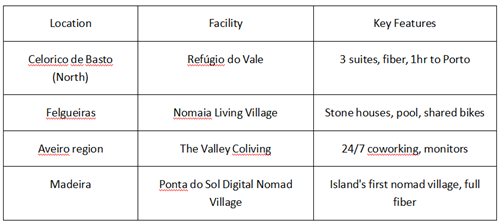
Verified Rural Coworking Options:
Croatia: Coastal Concentration, Rural Gaps
Croatian infrastructure remains heavily concentrated in coastal cities and tourist zones. While Zadar, Split, and Zagreb offer strong connectivity, inland rural areas face significant gaps.
Zadar Digital Nomad Valley (Verified Details):
Location: North of Zadar historic center
Accommodation: Studios to 3-bedroom cottages
Weekly rates: From €30; monthly ~€20
Constraints: 2-week minimum stay; 30-50% price increases June-August; winter facility reductions
Critical Infrastructure Gap: Croatia's 26% rural FTTH coverage places it 24th in EU rankings . Remote workers considering inland rural Croatia should verify specific address connectivity before committing.
Part 4: Cost of Living Reality (March 2026)
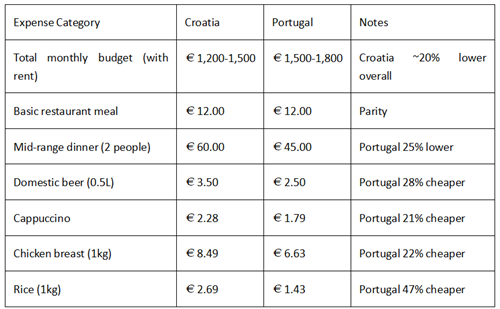
Key Insight: While Croatia's total cost is approximately 20% lower, Portugal offers better value on daily necessities due to supply chain efficiency. Croatia's savings concentrate in accommodation and seasonal tourism services.
Part 5: Decision Framework—Who Should Choose What
Choose Croatia If You:
Prioritize short-term tax optimization (1-36 months maximum)
Earn €0,000+ annually where tax savings justify temporary relocation costs
Accept mandatory departure after 36 months with no permanent residency accumulation
Prefer undiscovered destinations with lower tourist saturation
Have moderate connectivity needs (non-intensive video conferencing acceptable)
Seek Mediterranean coastal lifestyle at Central European prices
Choose Portugal If You:
Plan long-term European residence (5+ years)
Seek permanent residency or citizenship pathway (currently 5 years, verified)
Require guaranteed high-speed connectivity for professional obligations
Prefer established international communities with English-language support
Qualify for IFICI (researchers, certified startup employees, R&D roles)
Value year-round mild climate and infrastructure stability over short-term savings

Part 6: Critical FAQ—Correcting Common Misconceptions
Q: Is Croatia's DNV truly "completely tax-free"?
A: Foreign employment income is 0%, but capital gains (20-30%) and Croatian-source income (15-35%) still apply. Social security exemption means no pension accrual—a hidden long-term cost.
Q: Did Portugal extend citizenship requirements to 10 years in 2026?
A: No. The Constitutional Court ruled the proposed extension unconstitutional in December 2025; the 5-year requirement remains in force .
Q: What is Croatia's actual approval rate?
A: January-September 2024 data shows 824 applications with 342 approved—approximately 41.5% . Earlier claims of 48.8% appear to reference different time periods or calculation methods.
Q: Can I work for local companies on these visas?
A: No. Both prohibit local employment. Croatia explicitly bans any Croatian-source income; Portugal D8 requires non-Portuguese clients/employers.
Q: What happens after Croatia's 36-month maximum?
A: You must depart Croatia for 6 months before reapplying. Time spent on DNV does not count toward permanent residency or citizenship.
Part 7: Verified Resources and Next Steps
Official Government Sources
Croatia: Ministry of Interior (MUP) - Digital Nomad Visa
Portugal: AIMA Immigration Agency | Portuguese Tax Authority (AT)
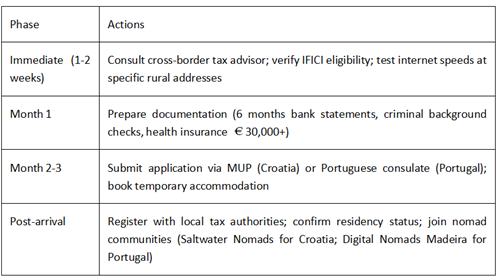
Recommended Action Timeline
Author: Dr. Elena Vuković-Morrison
Biography:
Dr. Elena Vuković-Morrison is a cross-border tax attorney and certified public accountant specializing in EU mobility taxation and remote work compliance. She holds a Juris Doctor from the University of Zagreb Faculty of Law and a Master of Laws (LL.M.) in International Taxation from the Vienna University of Economics and Business. Dr. Vuković-Morrison is a member of the Croatian Bar Association and the International Fiscal Association (IFA).
With over 12 years of practice split between Zagreb and Lisbon, she has advised 400+ digital nomads, remote employees, and location-independent entrepreneurs on tax residency optimization, visa structuring, and cross-border social security coordination. She previously served as a tax policy advisor to the Croatian Ministry of Finance during the 2020-2021 Digital Nomad Visa legislative development.
Dr. Vuković-Morrison maintains active legal practice licenses in both Croatia and Portugal (via the Portuguese Bar Association's foreign lawyer registration). She has personally resided under the Digital Nomad Visa in Zadar (2021-2022) and the D8 visa in Celorico de Basto (2023-2025), providing firsthand operational knowledge of both programs' practical administration.
Her analysis has been cited by the European Commission's Remote Work Policy Observatory, the OECD's Taxation of Remote Workers Working Group, and Tax Notes International. She is a regular contributor to the International Bureau of Fiscal Documentation (IBFD) and speaks annually at the Nomad Summit Europe on EU visa taxation trends.
Contact: [email protected] | LinkedIn: linkedin.com/in/elenavukovictax
Verification: Croatian Bar Association membership (0608/09) | Portuguese Ordem dos Advogados foreign registration (RA-2023-1847) | IFA member ID: HR-4451
Recommended for you