Romania's Comprehensive Guide for Rural Digital Nomads: Visa, Internet Speed, Rent and Hidden Costs

Author :Michael Reynolds|Last updated: April 2026
1. The Rural Romania Dream: Why Villages?
The image is tempting: a traditional wooden house in Transylvania, fiber-fast internet, organic food from your neighbor's garden, and rent under €00/month. As a former tax advisor who spent a year in Croatia's coastal cities before relocating to Romania's countryside, I can confirm this dream is partially achievable—but it comes with trade-offs that city-focused guides never mention.
Romania's 2025 digital infrastructure investments have transformed what's possible for rural remote workers. A €4 million project under the National Recovery and Resilience Plan (PNRR) is bringing high-speed fiber internet to nearly 1,000 remote localities, connecting over 78,400 households with speeds exceeding 300 Mbps . Pilot projects like "Digital Bridges" in Plaiuri village (Cluj County) have already demonstrated that even villages with previously unreliable mobile signals can now support remote work .
But infrastructure is only part of the story. This guide is for those specifically considering rural Romania—villages, small towns, and countryside communes rather than Bucharest or Cluj-Napoca.
1.1 Who This Rural Guide Is For
This article targets:
Long-term planners seeking EU residency through Romania's renewable digital nomad visa, but wanting to minimize living costs;
Nature-focused remote workers prioritizing hiking, skiing, or rural tranquility over urban nightlife
Budget optimizers who've realized that Romania's cities no longer offer the "€00 myth" but villages might;
Self-sufficient workers comfortable with solitude, limited English, and problem-solving without urban amenities;
US remote workers comparing rural Romania to rural Croatia or other Eastern European options
2. The Real Cost of Village Living: 2025 Data
2.1 Rental Reality: From €50 to €50
Rural Romania offers some of Europe's most affordable housing—but "rural" varies enormously:
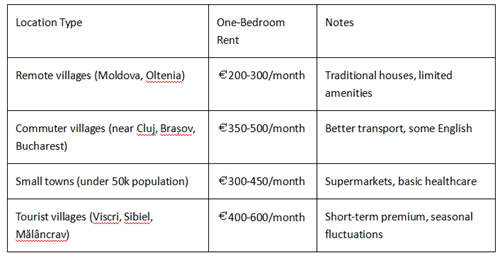
Critical insight: Unlike cities where rent is standardized, rural rentals are highly negotiable and often informal. Many villagers prefer long-term tenants and will drop prices for 12-month commitments paid upfront. However, you'll rarely find these listings on Imobiliare.ro or Storia—they're discovered through local connections, Facebook groups, or simply asking in the village pub.
Case Study: Sarah K., a UX designer from Oregon, rented a 3-room traditional house in a Maramureș village for €20/month in 2025. The catch? No central heating (wood stove only), 30-minute drive to the nearest supermarket, and she had to install her own fiber connection (Digi provided it for €0 setup).
2.2 The €00 "Village Comfort" Budget
Here's a realistic monthly budget for sustainable rural remote work:
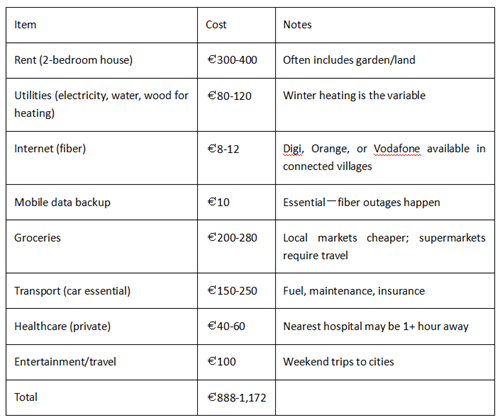
The €00 "survival mode" is possible in deep rural areas with wood heating, home-grown food, and minimal transport—but it's not sustainable for 12+ months of full-time remote work.
2.3 Hidden Costs of Village Life
Car Ownership is Non-Negotiable: Unlike cities with metro systems, rural Romania requires a car. Public buses between villages exist but run infrequently (sometimes once daily) . Budget €,000-5,000 for a reliable used car, plus €50-200/month for fuel and maintenance.
Heating Reality Check: Romanian winters hit -15°C (5°F) in mountain villages. Central heating is rare; most rural homes use wood stoves. Budget €00-500 for winter wood supplies or €00-150/month for electric heating (which strains older wiring).
Language Barrier Costs: Outside the younger generation in cities, English is rarely spoken in villages . You'll need a translator for rental contracts, utility setup, and any official matters. Budget €00-200 for initial translation assistance, or invest 6 months in learning basic Romanian.

3. Internet & Connectivity: The Make-or-Break Factor
3.1 The 2025 Rural Internet Revolution
Romania's rural internet situation has transformed dramatically. The 2025 PNRR project is laying 3,550 kilometers of fiber-optic infrastructure to connect 994 remote localities with speeds exceeding 300 Mbps . By early 2026, this rollout should be complete.
What's Already Available:
Digi: The budget champion, offering 300+ Mbps fiber in many small towns and some villages for €-8/month
Orange: The fastest network, with 371.7 Mbps average speeds and expanding rural fiber coverage
Vodafone: Strong 4G/5G coverage in rural areas, claiming 96% rural population coverage as of 2021
The Reality Check: While fiber is expanding, coverage is patchy. A village 20km from Cluj might have gigabit fiber, while another 50km from Bucharest still relies on 4G. Always verify specific address connectivity before signing a lease.
3.2 Mobile Coverage as Backup
Romania has surprisingly strong 4G coverage even in remote areas . Orange and Vodafone both claim 95%+ population coverage, though mountainous terrain creates dead zones.
Strategy: Always have a dual-SIM setup with two different providers (e.g., Orange + Digi) for redundancy. Mobile data plans cost €0-15/month for 10-50GB.
4. Healthcare, Amenities & Daily Life
4.1 Healthcare Access: The Rural Challenge
This is the biggest trade-off of rural Romania. While the country has universal healthcare, rural facilities are limited:
Village level: Basic health posts (căminul cultural) with nurses, rarely doctors
Small towns: General practitioners and basic clinics
Cities: Full hospitals (usually 30-90 minutes by car)
Recommendation: Budget for private health insurance (€0-60/month) covering private clinics in nearby cities. Companies like MedLife and Regina Maria have networks in major regional centers.
4.2 Shopping & Supplies
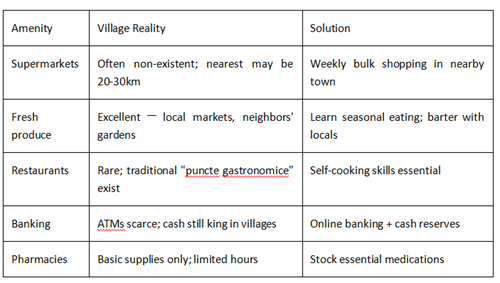
4.3The Language Barrier: Deeper Than Expected
"Outside of the younger generation in cities, English is rarely spoken in the villages" . This affects:
Rental negotiations: Contracts will be in Romanian; verbal agreements are common but risky
Utility setup: Calling Digi or Enel (electricity) requires Romanian or patience with translation apps
Community integration: Villagers are friendly but communication is limited to gestures and Google Translate.
Emergency situations: Medical emergencies, police interactions, car breakdowns
Mitigation strategy: Learn basic Romanian before arrival (A1 level minimum). Consider hiring a local fixer for your first month (€00-300) to handle setup tasks.
5. Tax Strategy for Rural Nomads
Romania's Law 69/2023 applies equally whether you're in Bucharest or a mountain village—but rural living affects your tax planning:
5.1 The 183-Day Rule Still Applies
Even in a remote village, you're subject to the same rolling 12-month day count. The isolation doesn't exempt you from tax residency rules.
Rural Advantage: Lower cost of living means you can more easily afford the "tax vacation" strategy—leaving Romania for 31+ days to reset your day count without breaking the bank.
5.2 Registering Your Rural Address
Romania's immigration office (IGI) requires a registered address for your residence permit. Rural rentals must provide:
A formal rental contract (notarized recommended)
Utility bills in your name or landlord's name at that address
Proof the property exists and is habitable (some villages have unregistered buildings)
Challenge: Some rural landlords are unfamiliar with the formal requirements for foreign residency permits. Budget extra time (and possibly a trip to the city IGI office) to resolve documentation issues.
6. Best Rural Regions for Digital Nomads
6.1 Transylvania's Commuter Belt (Near Cluj-Napoca)
Villages like: Florești, Apahida, Baciu (within 15km of Cluj)
Pros:
Fiber internet via "Digital Bridges" project
15-20 minute drive to Cluj's tech hub
Rent €50-450 vs. €20 in Cluj center
Some English due to tech workers living in villages
Cons:
Rapid gentrification; rents rising 15%+ annually
Losing "authentic village" feel as they become suburbs
6.2 Brașov's Mountain Villages
Villages like: Cristian, Râșnov, Prejmer, Zărnești
Pros:
Stunning mountain settings
One-bedroom rents €00-400
15-30 minutes to Brașov city
Strong tourist infrastructure (good restaurants, activities)
Cons:
Winter tourist season (Dec-Mar) pushes short-term rents up 20-30%
Mountain weather can isolate you during heavy snow
6.3 Maramureș: The Authentic Experience
Villages like: Breb, Săpânța, Vadu Izei
Pros:
UNESCO wooden churches, preserved traditions
Rent as low as €00-300 for traditional houses
True cultural immersion
Cons:
Limited internet (verify fiber availability—some villages have it, others don't)
2+ hours to nearest major city (Cluj)
Minimal English; strong dialect differences
Winter isolation
6.4 Moldova & Bucovina: The Budget Option
Villages like: Voroneț, Sucevița, around Iași
Pros:
Lowest rents in Romania (€00-280)
Beautiful monasteries and landscapes
Iași offers city amenities 30-60 minutes away
Cons:
Weaker infrastructure
Significant brain drain; fewer young people, less English
Hot, humid summers
7. The Croatia Comparison: Rural vs. Rural
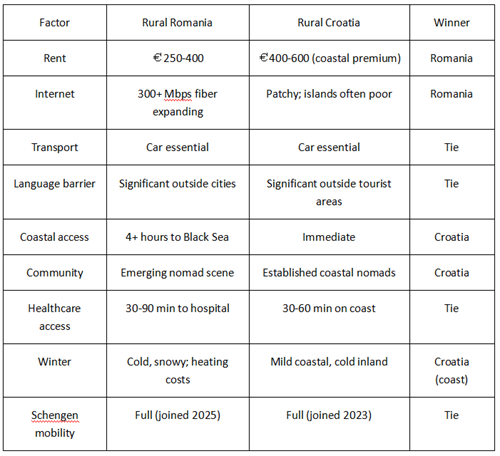
Bottom line: Rural Romania wins on cost and emerging infrastructure; rural Croatia (coastal) wins on lifestyle and community—but at 50-100% higher rent.
8. Practical Toolkit for Rural Nomads
8.1 Pre-Arrival Checklist (90 Days Before)
Connectivity Verification:
[ ] Contact Digi, Orange, and Vodafone to verify fiber availability at specific address
[ ] Request speed test data from current tenant if possible
[ ] Check nPerf coverage maps for your specific village
Hunting Strategy:
[ ] Join Facebook groups: "Digital Nomads Romania," "Expats in Transylvania"
[ ] Post in Romanian-language groups (use Google Translate): "Caut chirie în [village name]"
[ ] Budget 2-3 weeks for in-person house hunting—rural rentals aren't "click to book"
Documentation:
[ ] Prepare for notarized translations (€0-50/document)
[ ] Ensure your €,700/month income proof is solid—rural landlords may be skeptical of remote work
8.2 First 30 Days in the Village
Week 1: Survival Setup
[ ] Purchase local SIM cards from two providers (Orange + Digi recommended)
[ ] Install internet or verify mobile hotspot reliability for work
[ ] Stock 2-weeks of non-perishable food (village shops have limited hours)
[ ] Identify your "work backup plan" (nearest café with WiFi, co-working in nearby city)
Week 2: Integration
[ ] Meet the mayor (primar)—they control local knowledge and can solve problems
[ ] Find your "fixer"—a younger villager who speaks some English and can translate
[ ] Set up utility accounts (electricity, water, internet) with translation assistance
Week 3: Residency Formalities
[ ] Travel to nearest city IGI office for residence permit conversion
[ ] Register your rural address (may require landlord accompaniment)
[ ] Open local bank account (Banca Transilvania has good rural presence)
Week 4: Long-term Comfort
[ ] Arrange winter wood supply if applicable (order in summer for better prices)
[ ] Service your car; identify reliable local mechanic
[ ] Join regional expat WhatsApp groups for emergency support
8.3 Recommended Rural-Focused Resources
Internet Verification:
Digi coverage checker: www.digi.ro
Orange coverage map: www.orange.ro
nPerf interactive maps: www.nperf.com
Rental Finding:
OLX.ro (filter by "case" in rural communes)
Local Facebook marketplace groups
Word-of-mouth through Romanian expat forums
Community:
Facebook: "Digital Nomads Romania" (ask about specific villages)
Reddit: r/Romania and r/digitalnomad
FAQ
Q1: Can I survive in a Romanian village without speaking Romanian?
A: Technically yes, practically difficult. Basic tasks—renting, utilities, shopping—require at least A1 Romanian or a local fixer. Younger villagers (under 30) in commuter villages may speak some English, but don't count on it .
Q2: How reliable is rural internet for video calls?
A: In villages with fiber (increasingly common), extremely reliable—Romania's fiber speeds often exceed 300 Mbps . In villages without fiber, 4G can work but have backup plans for important calls. Always verify specific address connectivity before committing.
Q3: Do I need a car, or can I use public transport?
A: Car is essential for rural Romania. Village buses exist but may run once daily or less . For remote work requiring reliability, personal transport is non-negotiable.
Q4: What about winter isolation?
A: Mountain villages (Brașov area, Maramureș) can be snowed in during heavy winters. Ensure your accommodation has proper heating (wood stove or modern system), stock emergency supplies, and maintain your car for winter conditions.
Q5: Can I grow my own food?
A: Many rural rentals include garden land. Romania's soil is fertile; villagers often barter produce. This can significantly reduce your grocery costs and improve quality of life, but requires time and knowledge.
Q6: How do I handle medical emergencies in a village?
A: Identify the nearest hospital before moving. Private ambulance services exist but are expensive (€00-200 for transport). Consider living within 45 minutes of a city if you have health concerns.
Author Bio:
Michael Reynolds
Senior Immigration Policy Analyst, specializing in EU digital nomad visas and cross-border tax planning
Professional Background: Former EY Global Mobility Tax Advisor (2016€022); holds US CPA and Romanian Tax Advisor licenses
On-Ground Experience: Croatia digital nomad visa holder (2022€023, Split); Romania residence permit holder (2024–present, rural Transylvania)
Research Focus: EU digital nomad visa policy comparison, rural infrastructure development, US worldwide tax compliance
Contact: [email protected] | LinkedIn: linkedin.com/in/michaelreynolds-tax
Disclosure
Author currently holds Romanian residence permit and operates cross-border tax consulting business (Mobility Tax Consulting LLC). This article received no sponsorship from Romanian government, real estate developers, or visa agencies. Rural internet data sourced from Romania's PNRR project announcements and on-the-ground verification in Transylvania villages.
References
[1] ExpatFocus. (2026). Romania - Property Rental Prices. https://www.expatfocus.com/romania/guide/romania-property-rental-prices
[2] Global Property Guide. (2026). Romania's residential property market analysis 2026: Rental yields and price trends. https://www.globalpropertyguide.com/europe/romania/price-history
[3] Business Review. (2025). Plaiuri village in Cluj County, latest beneficiary of cutting-edge technology through "Digital Bridges" project. https://business-review.eu/tech/it/plaiuri-village-in-cluj-county-latest-beneficiary-of-cutting-edge-technology-through-digital-bridges-project-283926
[4] AmCham Romania. (2025). The list of villages connected to high-speed internet is growing rapidly. https://www.amcham.ro/news-from-members/the-list-of-villages-connected-to-high-speed-internet-is-growing-rapidly
[5] Romania Insider. (2025). Nearly 1,000 remote Romanian localities to get high-speed internet in EUR 94 mln project. https://www.romania-insider.com/internet-remote-localities-romania-pnrr-march-2025
[6] Romanian Friend. (2026). 10 Authentic Romanian Villages Where Rural Life Still Thrives. https://www.romanianfriend.com/blog/traditional-romanian-villages
[7] OECD. (2025). Access and quality of care in Romania's healthcare system. https://www.oecd.org/en/publications/oecd-reviews-of-health-systems-romania-2025_f52e4a98-en/full-report/access-and-quality-of-care-in-romania-s-healthcare-system_31f62789.html
[8] nPerf. (2026). 3G / 4G / 5G coverage map, Romania. https://www.nperf.com/en/map/RO/-/-/signal
[9] Europe Between East and West. (2024). History of Automobiles in Romania. https://europebetweeneastandwest.wordpress.com/tag/history-of-automobiles-in-romania/
[10] Opensignal. (2022). Romania Mobile Network Experience Report. https://insights.opensignal.com/reports/2022/01/romania/mobile-network-experience
Disclaimer
Information in this article is based on publicly available data, government announcements, and author's professional experience as of April 2025. Rural infrastructure varies dramatically by specific location—always verify internet, transport, and amenities for your exact intended address before making decisions. Immigration policies and tax regulations may change at any time. Readers should consult qualified immigration attorneys and tax advisors before making any decisions.
Last Updated: April 15, 2026
Next Scheduled Update: July 15, 2026 (or upon major policy changes)
Recommended for you