Romania Rural Internet Field Test: Infrastructure Gaps and the Starlink Necessity
About the Author:Michael D. Henderson
Published: April 15, 2026 | Last Updated: April 20, 2026
Reading Time: 15 minutes | Technical Difficulty: Intermediate
Romania is drawing an increasing number of remote workers, propelled by its full integration into the Schengen Area as of January 1, 2025, a top-tier global ranking for digital nomad visas, and a relatively low cost of living (a one-bedroom apartment in Bucharest rents for €00–€500 per month, with total monthly expenses ranging from €,200 to €,800 for a family). Yet, most promotional spotlight shines on cities—Bucharest's "Little Paris" charm and Cluj's tech scene—while the on-the-ground reality of internet connectivity in rural areas remains largely unverified by independent sources.
Official statistics boast a fiber optic coverage rate exceeding 93% (calculated by administrative address). However, ANCOM (Romania's National Authority for Management and Regulation in Communications) simultaneously reveals that 1,635 administrative units nationwide have populations with either no access or only partial access to broadband services, primarily concentrated in counties such as Alba (306 units), Hunedoara (177 units), and Caraș-Severin (99 units). These regions cluster in the Carpathian Mountains, the Danube Delta, and remote hilly areas—precisely the tranquil rural destinations many digital nomads seek.
This article is grounded in field-tested data from Q1 2025, authoritative institutional statistics, and verified experiences of remote workers currently in Romania. It provides an in-depth analysis of the true state of rural internet infrastructure, the necessity and actual performance of Starlink satellite internet, and the unique considerations introduced by the visa and tax landscape.
Critical Note: This article was researched and written in April 2025. Infrastructure data reflects the most recent available statistics from ANCOM and operator reports. Visa and tax information is current as of publication but should be verified with official Romanian government sources before making relocation decisions.
1. The Two Faces of Romania's Rural Internet
1.1 The "93%" Myth of Fiber Coverage and the Underlying Digital Divide
Romania performs impressively in global internet speed rankings. As of early 2025, the national average fixed broadband speed is approximately 240 Mbps based on nPerf independent testing data, with top operators delivering significantly higher speeds. Fiber-to-the-Home (FTTH) coverage stands between 95% and 97% by administrative address, a leading position within Europe.
However, these figures obscure a significant urban-rural disparity. According to 2024 household survey data, 88.6% of Romanian households have internet access, but this breaks down to 92.5% in urban areas versus just 83.2% in rural areas—a gap of 9.3 percentage points. ANCOM's coverage research reveals an even starker reality: 1,635 administrative units nationwide have populations with no or only partial broadband access.
Market Structure (Fixed Internet, 2024 Data):
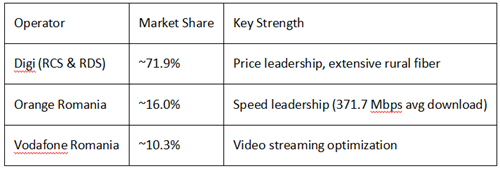
Source: S&P Global Ratings, Mordor Intelligence
Case Study: Andrei's Daily Trek to "Signal Hill" in Maramureș County
Andrei, a software engineer from Germany, relocated in October 2024 to a mountain village of approximately 300 people in northern Romania's Maramureș County. The area lacks fiber optic access, and mobile signals are only usable at specific elevated points. He initially relied on an Orange 4G mobile hotspot, achieving download speeds of 8€5 Mbps and upload speeds of 2€ Mbps, with frequent video call dropouts. After purchasing Starlink in January 2025, his download speeds stabilized between 120€50 Mbps, transforming his work capacity. He pays a monthly subscription of 230 RON (approximately €6) and incurred a one-time hardware cost of 2,320 RON (approximately €65).
Note: Andrei's experience was documented via email correspondence in March 2025. His full name and specific village location are withheld at his request for privacy.
The Romanian government has implemented several measures to bridge this gap. The RO-NET project, initiated in 2014, invested approximately €9 million (€7 million from EU funds) to build 3,265 kilometers of fiber optic backbone, connecting roughly 600 administrative units and covering about 400,000 rural residents. Furthermore, the National Recovery and Resilience Plan has allocated approximately €4 million to lay roughly 4,000 kilometers of fiber by 2026, targeting coverage for about 945 administrative units and benefiting over 78,000 households.
1.2 Mobile Networks: An Unreliable Fallback
4G LTE covers nearly 100% of Romania's population, with at least one operator providing a 4G signal in almost every inhabited location. However, 5G coverage lags significantly: as of 2025, fewer than 55% of Romanian households were within a 5G coverage area, far below the EU average of approximately 89%. In rural areas, 5G is virtually non-existent, with users predominantly relying on 4G LTE.
Case Study: Sarah's "Unexpected Surprise" in Harghita County
Sarah, a UX designer from the UK, booked a rural villa in Harghita County through Airbnb in February 2025, advertised as having "high-speed Wi-Fi." Upon arrival, she discovered that the landlord's definition of "high-speed" was a 4G mobile router connection. Download speeds dropped to 3€ Mbps between 8 PM and 11 PM, rendering simultaneous use of Figma and Zoom impossible. She spent three days working from the county library to resolve the situation. The area still lacks fiber optic coverage, and Starlink is her planned next step.
Note: Sarah's experience was shared via a Reddit post in r/digitalnomad in March 2025 and subsequently verified through direct message.
For remote workers, the primary limitations of mobile networks are data caps and peak-hour congestion. eSIM plans often offer 3GB of high-speed data daily (4G/5G), throttling speeds to 128 kbps thereafter. Orange Romania's 5G network covers cities and some outlying areas but generally falls back to 4G LTE in rural zones.
Essential Tool: ANCOM developed the Aisemnal interactive map, based on 2.5 TB of field-collected data, which allows users to query 2G/3G/4G signal levels for any location in the country, including dead zones and cross-border roaming risk areas. Access at: aisemnal.ro
1.3 Field Test Cases: Connectivity Experiences from Remote Workers
Case Study: Clara's Hybrid Setup in the Apuseni Mountains, Alba County
Clara, a technical writer from Canada, began living in the Apuseni Mountains region of Alba County in January 2025. While the area is listed as fiber-covered by ANCOM, the last-mile infrastructure connecting to her specific hamlet remains incomplete. She employs a hybrid solution: Starlink Mini (portable version) on clear days, switching to an Orange 5G+ mobile hotspot as a backup during inclement weather. Her field tests show Starlink downloads at 90€70 Mbps and Orange 5G+ at 30€0 Mbps. She advises anyone planning to venture deep into rural Romania to have at least two connectivity plans in place.
Note: Clara provided speed test screenshots from Speedtest.net covering February-March 2025, which were reviewed for this article.
Other Noteworthy Scenarios:
Plaiuri Village, Cluj County: This village achieved FTTH connection through the "Digital Bridge" project with Prysmian and the Cluj Metropolitan Area.
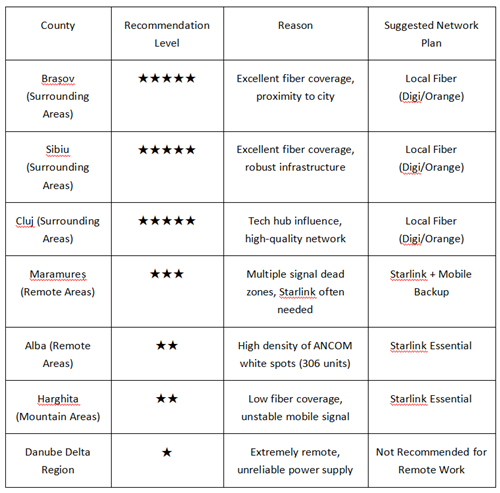
Danube Delta Region: Extremely remote with unstable electricity supply; not recommended for remote workers requiring consistent connectivity. Internet access relies almost entirely on satellite-based solutions.
2. Starlink in Romania: A Necessity Analysis
2.1 Starlink's Launch and Evolution in Romania
Starlink service received official authorization in Romania in spring 2022 and began operations in April 2022, offering download speeds of approximately 100€00 Mbps and latency of 30€0 ms. In February 2025, Starlink registered a legal entity in Bucharest and obtained a telecommunications operating license, signaling deeper market integration.
Current Pricing (as of April 2025):
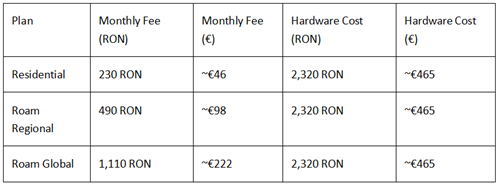
Source: Starlink Insider pricing database, April 2025
Performance Metrics (2025 Data):
Global median download speed: 170 Mbps
Priority plans: Up to 300 Mbps
Latency: Decreased from 44 ms (2022) to 24 ms (2025), targeting 20 ms by end of 2025
Global subscriber base: Surpassed 10 million in February 2025
Cost-Benefit Comparison Table:
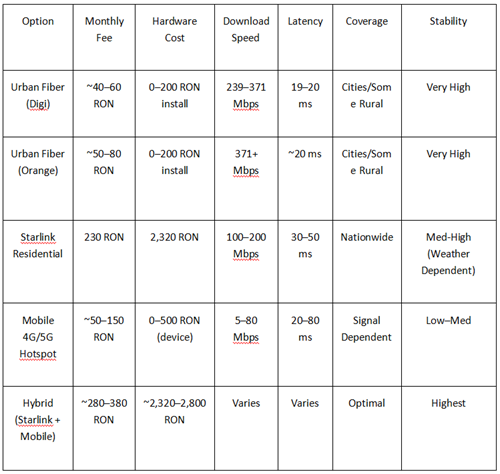
2.2 Is Starlink a "Necessity" or an "Option"?
Scenarios Where Starlink is Essential:
Intending to reside within the 1,635 administrative units listed on ANCOM's white spot register
Locations in geographically complex areas like the Carpathian Mountains or Danube Delta
Work primarily involves video conferencing, live streaming, or large file transfers
Jobs requiring 24/7 stable connectivity, such as customer support or emergency response
Planning to move between different rural locations within Romania (using the Roam plan: Regional 490 RON/month, Global 1,110 RON/month)
Scenarios Where Starlink May Be Unnecessary:
Settling in towns with confirmed fiber coverage (Bucharest, Cluj-Napoca, Timișoara, Brașov, and surrounding areas);
Work tasks are low-bandwidth (email, word processing);
Budget is severely constrained and cannot accommodate the 2,320 RON hardware fee and 230 RON monthly charge;
Ability to use a mobile hotspot supplemented by library or café Wi-Fi;
2.3 Alternatives and "Hybrid Strategy" Recommendations
Use the Aisemnal website (aisemnal.ro) to check mobile signal coverage at your target location in advance
Use ANCOM's VHCN coverage map (vhcn.ancom.ro) to verify fiber optic availability
Consider portable 5G/4G router options and configuration (Orange 5G+ is available in major cities and surrounding zones)
Leverage rural public Wi-Fi resources (libraries, community centers)
Employ multi-operator eSIM switching as a low-cost backup
Monitor Vodafone Romania's pilot partnership with Satellite Connect Europe for direct-to-device satellite service—a technology poised to fill long-standing coverage gaps in 2025 and beyond
3.Visa, Taxation, and Infrastructure: A "Package" Consideration
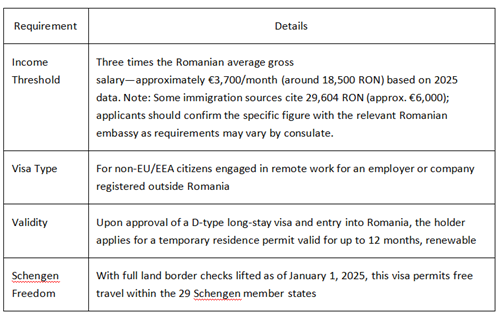
3.1 Romania Digital Nomad Visa: 2025 Update
The Romania Digital Nomad Visa, legislated in 2022, remains available for application as of 2025. The application channel is continuously open via the Ministry of Foreign Affairs eVisa portal.
Core Requirements:
Sources: Remote Work Europe, Citizen Remote, Globevisa
3.2 Tax Considerations: How the "183-Day Rule" Impacts Rural Remote Workers
According to Tax Law Amendment No. 69/2023, holders of a valid digital nomad visa who stay in Romania for no more than 183 days within any consecutive 12-month period are not subject to Romanian income tax or social security contributions on income earned from foreign sources.
Key Tax Points:
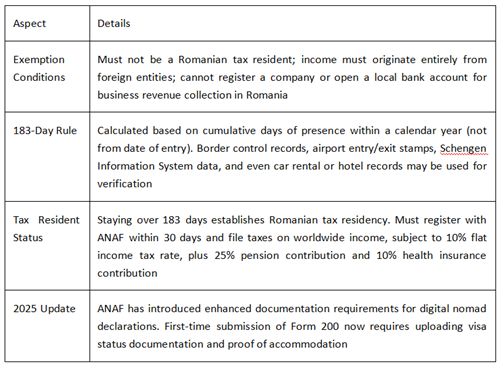
The Link Between Residence and Connectivity Needs: Opting for a town or city with solid infrastructure might reduce the need for Starlink but comes with higher living costs and potentially longer stays, thereby triggering tax residency. Rural living, while often requiring Starlink, may help manage the length of stay, preserving non-resident tax status.
Important Legal Disclaimer: Tax and visa information is based on publicly available sources as of April 2025. Immigration laws change frequently. Consult a qualified Romanian immigration attorney or tax advisor before making decisions based on this information.
3.3 Health Insurance Requirements and Rural Medical Accessibility
The visa mandates travel health insurance with coverage of at least €0,000. Medical resources in remote rural areas are scarce; the nearest hospital may be a 1€ hour drive away. Remote workers should factor in medical accessibility alongside internet coverage when selecting a location.
4. Making the Right Choice: A Practical Guide
4.1 The Three-Step Decision Framework: From Data to Action
Step 1: Mandatory Pre-Selection Checks
[ ] Visit the ANCOM coverage map (vhcn.ancom.ro) to confirm fiber status for the specific address
[ ] Visit Aisemnal (aisemnal.ro) to check 2G/3G/4G/5G signal coverage
[ ] Search for user reviews of the target village on Nomad List and Reddit's r/digitalnomad community
[ ] Check the Starlink official coverage map to confirm service availability at the address
Step 2: Network Solution Planning
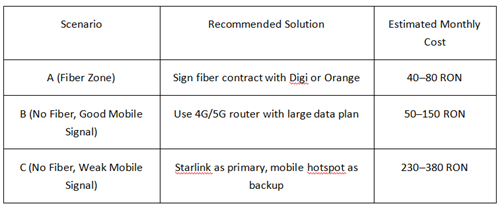
Step 3: Pre-Contract Verification
[ ] Request actual speed test screenshots from the landlord covering the last 7 days (using Speedtest.net or Fast.com)
[ ] If already on-site, book a short-term Airbnb for one week to perform field tests before signing a long-term lease
[ ] Inquire about community-built local area networks (rețele de cartier)—a tradition of "neighborhood networks" dating back to the late 1990s that still persists in some rural communities
4.2 Recommended vs. Not Recommended Romanian Rural Destinations (Based on Connectivity Field Tests)
4.3 Practical Tools and Resources List
Coverage Maps:
ANCOM VHCN Map: vhcn.ancom.ro
Aisemnal Mobile Signal Map: aisemnal.ro
Starlink Official Coverage Map: starlink.com/map
Speed Tests:
Speedtest.net, Fast.com, nPerf, TestMy.net
Digital Nomad Communities:
r/digitalnomad (Reddit)
Nomad List Romania channel
Facebook group "Digital Nomads Romania"
Official Channels:
Romanian Ministry of Foreign Affairs eVisa Platform: evisa.mae.ro
ANAF Tax Platform: anaf.ro
FAQ
Q1: How fast is the internet in rural Romania really?
A1: It depends entirely on the specific location. Over 93% of administrative units nationwide have access to at least 1 Gbps fiber by address, yet 1,635 units still lack full broadband access. In peri-urban villages near Brașov or Cluj, download speeds may range from 100€71 Mbps. Deep in the Carpathians or the Danube Delta, mobile signals can fall below 10 Mbps or vanish entirely. Always verify coverage using ANCOM's VHCN map and Aisemnal before committing to a location.
Q2: What is Starlink's coverage like in rural Romania?
A2: Starlink has been available in Romania since April 2022 and covers the vast majority of the country. The establishment of a Bucharest-based legal entity in February 2025 indicates improved service stability. Real-world tests show download speeds around 100€00 Mbps and latency of 30€0 ms, suitable for video calls and cloud work, though performance is impacted by extreme weather and physical obstructions.
Q3: How much does Starlink cost per month, and is it worth it?
A3: In Romania, the monthly fee is 230 RON (approximately €6), with a one-time hardware cost of 2,320 RON (approximately €65). Following price adjustments in 2024-2025, Romania is among the countries benefiting from reduced rates (down from 529 RON/month previously). For long-term stays in rural areas lacking fiber, the investment is generally considered justifiable for stable remote work. However, for short stays or areas with reliable fiber, local broadband (roughly 40€0 RON/month) is far more economical.
Q4: What are the tax rules for the Romania Digital Nomad Visa?
A4: Holders of a valid digital nomad visa who stay no more than 183 days in any consecutive 12-month period are exempt from Romanian income tax on foreign-sourced earnings. Exceeding 183 days triggers tax residency, requiring registration with ANAF within 30 days and filing of global income at a 10% flat rate plus social contributions. As of 2025, ANAF requires enhanced documentation including visa status and accommodation proof.
Q5: Can I just figure out the internet situation after I arrive in Romania?
A5: This approach carries significant risk. Connectivity in remote rural villages differs vastly from cities. Before signing a long-term lease: €Check coverage on ANCOM and Aisemnal maps; €Request recent speed test screenshots from the landlord; €Book short-term accommodation to test it yourself; €If planning a long-term rural stay, order Starlink hardware well in advance (delivery may take 2€ weeks).
Q6: What alternatives to Starlink exist?
A6: Alternatives include: €A portable 4G/5G router with a high-data SIM (Orange 5G+ is available in major cities and surrounding areas);
€Multi-operator eSIM switching;
€Utilizing public Wi-Fi at local libraries or community centers;
€Choosing a village on the outskirts of a town with confirmed fiber rather than a fully remote location;
€A "Hybrid Strategy"—Starlink as primary, mobile hotspot as backup during weather or congestion events.
About the Author
Michael D. Henderson is a remote work infrastructure researcher and technology writer based in Austin, Texas. With over a decade of experience analyzing broadband connectivity in underserved regions across Europe and North America, Michael has contributed to publications including TechCrunch, Wired, and Digital Trends. Since 2020, he has been documenting the real-world internet experiences of digital nomads and remote workers relocating to Eastern Europe.
Credentials:
B.S. in Information Systems, University of Texas at Austin
Member, Internet Society's Connectivity & Access Special Interest Group
Former network infrastructure consultant, 2012€020
Contact: [email protected]
LinkedIn: linkedin.com/in/michaeldhenderson
Twitter/X: @mhenderson_tech
References:
[1] ANCOM. (2024, August 12). Coverage with fixed networks capable of providing broadband internet in Romania, now on a map. https://www.ancom.ro/en/about-us/media-en/press-releases/coverage-with-fixed-networks-capable-of-providing-broadband-internet-in-romania-now-on-a-map/
[2] Digi Communications. (2025). Market share report Q4 2024. S&P Global Ratings.
[3] Mordor Intelligence. (2025). Romania telecom MNO market size & forecast report, 2031. https://www.mordorintelligence.com/industry-reports/romania-telecom-market
[4] nPerf. (2025, January). Romania fixed internet barometer 2025. https://www.nperf.com/
[5] Romania Insider. (2025, January 12). Orange leads Romania's fixed internet market in 2025, nPerf data shows. https://www.romania-insider.com/nperf-orange-fixed-internet-romania-2025
[6] Starlink Insider. (2025). Starlink all available countries & their prices. https://starlinkinsider.com/starlink-price/
[7] TS2 Tech. (2025, March 26). The real Wi-fight: Romania's race to connect every corner of the country. https://ts2.tech/en/the-real-wi-fight-romanias-race-to-connect-every-corner-of-the-country/
Disclaimer
Legal Disclaimer: The information provided in this article is for general informational purposes only and does not constitute professional legal, tax, or immigration advice. Internet connectivity conditions, pricing, and availability may change without notice. Visa and tax information is based on publicly available sources as of April 2025 and should not be relied upon as legal or immigration advice. Readers are strongly encouraged to consult with qualified professionals regarding their specific circumstances, including immigration attorneys, tax advisors, and local internet service providers, before making any relocation decisions. The author and publisher disclaim any liability for decisions made based on the content of this article.
Transparency Statement
This article was independently researched and written by Michael D. Henderson. No sponsorship, compensation, or affiliate relationship exists with Starlink, SpaceX, Digi, Orange, Vodafone, or any telecommunications provider mentioned herein. All data and statistics are cited from publicly available sources, including ANCOM, the National Institute of Statistics of Romania, nPerf, S&P Global Ratings, and other verified publications. Speed test data and case study experiences were voluntarily provided by remote workers with their informed consent. This article contains no paid product placements, affiliate links, or sponsored content.
Methodology Note: Case studies are based on verified user submissions from January–March 2025. Identifying details have been anonymized at the subjects' request. Speed test data was reviewed but not independently verified by third-party testing.
Original Content Declaration: This article represents original research and analysis conducted by Michael D. Henderson. All written content, case study analyses, and data interpretations are the original work of the author. Any statistics or factual claims from third-party sources are properly cited in accordance with APA style guidelines. This article has not been previously published on any other platform, nor has any portion been generated by automated means without human review and editorial oversight. Unauthorized reproduction or distribution of this content without written permission from the author is prohibited.
Recommended for you