Italian Digital Nomad Visa vs. Portuguese D8: Why is the less stringent Italian visa harder to get approved?
About the Author : Jonathan R. Whitfield, Esq.| Last Updated: April 13, 2026
If you're considering relocating your office to the olive groves and vineyards of Southern Europe, you've likely encountered two names: the Italian Digital Nomad Visa and the Portuguese D8 Visa. But you may not yet be aware of a critical paradox:
By the end of 2025, Portugal had issued over 2,600 D8 visas, while Italy's Digital Nomad Visa—launched on April 4, 2024—had seen fewer than 500 actual approvals (based on immigration lawyer community estimates). Even more puzzling: Italy's annual income threshold is only €8,000 (approx. $30,800), significantly lower than Portugal's €4,160 (approx. $48,600). Yet Italy's application success rate lags far behind Portugal's—immigration lawyers estimate that up to 35% of Italian visa applications are rejected due to "proof of accommodation" and "skills assessment" issues, whereas Portugal's D8 rejection rate is under 15%.
Why does this happen? The answer lies in a keyword you might overlook: system maturity. This is not a metric you'll find on any official application guide, but it is the decisive factor determining whether you'll smoothly secure a visa and truly begin your Southern European life.
1. Core Comparison: Not About Threshold Levels, But System Maturity
1.1 Side-by-Side Visa Parameter Comparison Table
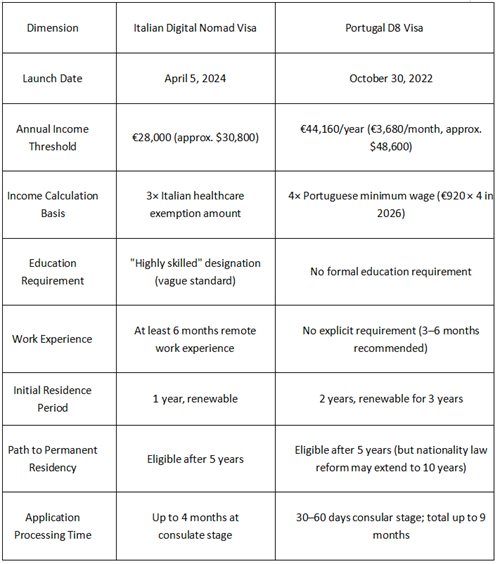
1.2 Key Insight: Threshold €Approval Rate
Italy's "Highly Skilled" Subjective Trap
The biggest hidden hurdle for the Italian visa is not the €8,000 income line but the ambiguous standard of "highly qualified worker." According to Article 27-quater of Italian immigration law, "highly skilled" is defined as: holding a three-year university degree, or having at least 5 years of relevant professional experience (3 years for the ICT sector). In practice, however, different consulates interpret this standard very differently:
Computer science degree + 3 years remote development experience €€Typically approved
Marketing degree + 2 years freelance writing €Additional portfolio and client contracts required;
outcome uncertain
No degree + 5 years design experience €€Some consulates reject outright
This subjectivity means that even if your annual income is €0,000, you could still be rejected if your education or experience is not deemed "highly skilled." Key advice: Your income documentation should significantly exceed the €8,000 threshold (€5,000+ recommended) to compensate for uncertainties in the skills assessment.
Portugal's System Maturity Advantage
In contrast, Portugal's D8 visa approval process is highly standardized. Although AIMA (Agency for Integration, Migration and Asylum) faces a historical backlog, the D8 visa is treated as a "priority processing" category and is relatively less affected. Consular approval typically takes 30€0 days, with total processing time (including residence card conversion) up to 9 months.
More importantly, Portugal's D8 visa has no education requirement—as long as you can prove remote income meeting the threshold, you will not be rejected due to "skills assessment," regardless of whether you hold a university degree.
2. In-Depth Analysis: Italy's "Hidden Battlefield"
2.1 Proof of Accommodation: The Biggest Application Trap
This is the most overlooked—and most rejection-prone—aspect of the Italian Digital Nomad Visa application.
Official Requirements vs. Reality: Official documents merely require "suitable proof of accommodation," but most consulates in practice demand a long-term lease contract (standard 4-year Italian contract) already registered in Italy, not a simple hotel booking or Airbnb confirmation. This creates a fundamental conflict with the nomadic nature of digital nomads—you may need to commit to a one-year lease you might never fully use.
Risk Factor: Applicants must sign a lease before visa approval, bearing the substantial risk of paying rent for a visa that may never materialize. This is consistently cited as one of the biggest obstacles in Italian consular practice.
2026 New Developments: On March 2, 2026, Italy's Ministry of Interior, together with the Ministry of Labor and Ministry of Foreign Affairs, issued long-awaited implementation guidelines, but the specific requirements for proof of accommodation remain vague. Some consulates are beginning to accept hotel bookings of 30+ days, but this flexibility varies by consulate and is not guaranteed.
Practical Advice: If you choose the Italian route, consider long-term rental options via platforms like Airbnb (with official invoices and host declarations) rather than directly signing a standard Italian 4-year contract. Alternatively, consider entering Italy first on a tourist visa to secure housing in person before submitting your visa application—but the legal compliance of this approach should be confirmed with a qualified immigration lawyer.
2.2 The Grey Area of "Highly Skilled" Assessment and Coping Strategies
Beyond the aforementioned education/experience requirements, there are additional "highly skilled" assessment traps:
Self-Employed vs. Employee Distinction: The Italian visa distinguishes between "digital nomads" (self-employed) and "remote workers" (employees). For employees (remote workers), in addition to basic requirements, you must provide an employment contract compliant with Italian national salary standards and a declaration from the employer confirming no criminal immigration record. Moreover, an annual salary not lower than the ISTAT-reported average gross salary (approx. €4,000) is recommended for employees.
Industry Preferences: While no official occupation list exists, feedback from immigration lawyers indicates higher approval rates in fields like IT, engineering, design, and consulting. Creative professions (e.g., content creation, artistic design) without strong academic credentials are more likely to face requests for supplementary documentation.
Coping Strategies:
Prepare detailed skills documentation in advance: degree certificates (translated and authenticated), professional qualifications, portfolio, client contracts, recommendation letters
Income significantly above the minimum threshold (€5,000+) can partially compensate for lack of education/experience
If you lack a university degree but have extensive experience, prepare a detailed skills explanation letter describing how your professional field meets the "highly skilled" definition
2.3 2025 Fingerprinting Requirement and 2026 Implementation Guidelines
Fingerprinting: Since January 11, 2025, all Italian long-stay visa (Type D) applicants must undergo fingerprint collection at the consulate. Practical impacts include: 15€0 days longer processing times and tighter appointment availability. For U.S. applicants, this means planning your application timeline 3€ months in advance.
Major Update in 2026 Implementation Guidelines: The implementation guidelines issued on March 2, 2026, brought important good news—clarifying that the "nulla osta" (clearance) processing time is 30 days, and visa issuance is 15 days. Consulates officially began accepting applications on March 18, 2026.
However, note: Whether this 45-day "efficiency target" will be met in practice remains to be seen. The operational efficiency of Italian bureaucracy varies regionally; it is advisable to allow a 3€ month buffer.
3. Portugal D8: The Hidden Costs of a Mature System
3.1 The Real Impact of AIMA's Backlog Crisis
At the end of 2023, Portugal's former immigration service SEF was dissolved, and the newly established AIMA inherited approximately 400,000 backlogged cases. This initially sparked widespread concern. However, the latest update is: by the end of 2025, AIMA had processed approximately 90% of the backlog, and the government has pledged a "zero-wait" processing model by 2026.
Actual D8 Visa Processing Times:
Consulate visa stage: 30€0 days
AIMA residence card appointment: 1€ months after entry (varies by location and season)
AIMA card production: up to 90 days
Total timeline: 4€ months to receive physical residence card
It is important to note that requirements vary among Portuguese consulates. One American applicant who applied through the Newark consulate in 2025 shared: "Every consulate has its own requirements. Figuring out exactly what is needed for the D visa is confusing and not transparent. I ended up hiring a law firm anyway, though I later realized over 90% of the info could be found online by myself." This applicant's AIMA appointment was scheduled for March 2026—months after visa approval.
3.2 The "Earthquake" of 2025€026 Nationality Law Reform
This is currently the most uncertain factor affecting the long-term value of the Portugal D8 visa. On October 28, 2025, the Portuguese Parliament passed an amendment to the nationality law, proposing to extend the residency requirement for non-EU citizens from 5 years to 10 years. On December 15, 2025, the Constitutional Court ruled some provisions unconstitutional. At the end of March 2026, three major parties submitted competing amendments.
On April 2, 2026, Parliament passed a revised nationality law, but the extension of the residency period for naturalization remains undetermined following the Constitutional Court ruling. The President may sign, veto, or refer it again to the Constitutional Court.
Strategic Recommendations for D8 Applicants:
If naturalization is a core goal, submit your application before the law is finalized—typically "grandfather clauses" protect existing applications
Even if the naturalization period is extended, the D8 visa remains a valid path to long-term EU residency; you can still apply for permanent residency after 5 years
Closely monitor final decisions from the Constitutional Court and President; this process may continue for months
3.3 Dynamic Adjustments to Income Requirements
Portugal's D8 visa income threshold is directly tied to the minimum wage, meaning it changes annually:
2025: €,480/month (4 × €70)
2026: €,680/month (4 × €20)
Family add-on requirements: Spouse +50% (€,840/month), Child +30% (€,104/month)
Additionally, Portugal requires proof of savings: €1,040 for single applicant (3 months' income), €,520 additional for spouse, €,312 additional per child.
3.4 The Reality of Taxation: NHR is Dead—What Now?
Portugal's popular Non-Habitual Resident (NHR) tax regime closed to new applicants on January 1, 2024. Its replacement, IFICI (Tax Incentive for Scientific Research and Innovation, also known as NHR 2.0), has a very narrow scope—it applies only to highly qualified professionals working in science, technology, innovation, and R&D, offering a 20% flat tax rate.
For most digital nomads, IFICI's threshold is too high—it requires a university degree or recognized professional experience, and the work must be within innovation, science, or R&D fields. Community feedback indicates "IFICI is not applicable for over 95% of participants."
Actual Tax Burden: If you reside in Portugal for more than 183 days, you will be subject to standard progressive tax rates (14.5% to 48%), plus social security contributions (approx. 21.4% for self-employed individuals). The good news is that Portugal has double taxation treaties with countries like the U.S., preventing the same income from being taxed twice.
An Easily Overlooked Risk: The D8 visa requires that the majority of your income (>50%) must come from entities outside Portugal. If you work for a Portuguese company, you may be unable to renew your visa or face cancellation.

4. Case Comparisons: Three Typical Applicant Profiles
4.1 Case A: Senior Software Engineer ($120,000 Annual Salary)
Background: Master's degree in Computer Science, 5 years remote work experience, single, employed by U.S. tech company
Italian Route Analysis:
Advantages: Income far exceeds €8,000 threshold; education highly aligned with "highly skilled" requirement
Core Risk: Proof of accommodation—need to sign Italian lease in advance
Timeline: Consular approval up to 4 months, plus accommodation arrangement, total 90€20 days
Taxation: Impatriati regime not applicable (does not meet 3-year overseas residence requirement); standard progressive rates 24%€5% apply. If opting for self-employment (flat-rate regime), 5% substitute tax possible for first 5 years
Portuguese Route Analysis:
Advantages: No education authentication hassles; mature AIMA process
Cost: Annual income threshold about €6,160 higher, but lower cost of living (€,100 vs €,400/month)
Taxation: IFICI may apply (if qualifying in innovation field); otherwise standard progressive rates
Timeline: 30€0 days consular processing, total 4€ months
Recommendation: Portugal D8—prioritize system stability, more predictable approval, greater long-term tax optimization potential
4.2 Case B: Freelance Designer ($35,000 Annual Income)
Background: Bachelor's degree in Arts, 2 years freelance experience, non-working spouse
Italian Route Analysis:
Income Requirement: Main applicant €8,000 + spouse €80×12 = €7,360/year (close to or meeting threshold)
Advantages: Italy's process for self-employed individuals relatively mature; lower spouse reunion threshold
Risks: "Highly skilled" assessment uncertain—Arts degree + only 2 years experience may not be recognized by all consulates; spouse income add-on raises effective threshold further
Key: Detailed portfolio and client contracts needed to prove "highly skilled"; income slightly above threshold recommended to increase success rate
Portuguese Route Analysis:
Income Requirement: Main applicant €,680/month + spouse 50% (€,840) = €,520/month = €6,240/year
Obstacle: Family income requirement far exceeds actual income; nearly infeasible
Savings Requirement: Main applicant €1,040 + spouse €,520 = €6,560
Conclusion: Without significant income increase, Portuguese route effectively unfeasible
Recommendation: Italian Digital Nomad Visa—but strengthen skills documentation; prepare €,000€0,000 savings as supplementary financial proof
4.3 Case C: Family Remote-Working Couple (Main Applicant $80,000 Salary, Non-Working Spouse, 1 Child)
Background: Bachelor's degree in Marketing, 3 years remote experience, employed by U.S. company
Italian Route Analysis:
Income Requirement: €8,000 + spouse €80×12 + child €30×12 = €8,920/year (salary $80,000 €€3,000, well above requirement)
Additional Costs: Health insurance for entire family covering €0,000+ (family plan approx. €,500€,500/year)
Advantages: Family reunion threshold relatively reasonable; income well above threshold increases approval probability
Challenge: Proof of accommodation must consider family size (at least two-bedroom unit)
Portuguese Route Analysis:
Income Requirement: Main applicant €,680 + spouse 50% (€,840) + child 30% (€,104) = €,624/month = €9,488/year
Savings Requirement: Main applicant €1,040 + spouse €,520 + child €,312 = €9,872
Obstacle: €9,488/year family income requirement approaches $87,000; for $80,000 main applicant income, threshold barely met with no buffer
Risk: Income exactly at threshold; adjudicator may question financial stability
Recommendation: Italian Visa—family-friendly design, income threshold far lower than Portugal. For family applicants, Italy's digital nomad visa is clearly more accommodating in income calculation. Note, however, that dependent income requirements for family reunification are cumulative per person; ensure accurate calculation beforehand
5. Special Considerations for Rural Remote Work (Target Reader Exclusive)
If you are an American remote worker planning to immerse yourself in the countryside of Southern Europe—whether for lower costs, a quieter life, or an authentic Italian or Portuguese experience—here is what you need to know:
5.1 Rural Italy: Opportunities and Challenges Coexist
Opportunities:
€ Home Programs: Some rural Italian areas (e.g., Sicily, Ollolai in Sardinia) offer € housing or € accommodation programs specifically targeting digital nomads. Note that these often come with renovation obligations or minimum stay requirements.
Southern Cost Advantage: Cost of living in regions like Sicily and Calabria is 40% lower than in the north—single monthly expenses can be kept to €00€,000.
"Work in the South" Tax Incentives: Some regions offer additional tax benefits to attract long-term professionals.
Challenges:
Internet Infrastructure: Fiber optic coverage in rural southern Italy is only about 36.8%, far below the EU average of 60%. This means you may need to rely on Starlink. Good news: Lombardy region has launched a €.1 million Starlink pilot project to address rural connectivity gaps. Starlink in Italy costs about €0€0/month, equipment fee around €50.
Low English Proficiency: English usage in rural areas is extremely limited. Handling administrative procedures (e.g., residence permits, tax registration) essentially requires Italian proficiency or hiring a translator.
Significant Regional Healthcare Disparities: The density and quality of public healthcare resources in southern regions are notably lower than in the north.
5.2 Rural Portugal: More Mature Infrastructure
Opportunities:
Extremely Low Rents: One-bedroom apartments in Portugal's interior (e.g., Guarda, Castelo Branco) can be found for €00€00/month or even less.
Mature Digital Nomad Communities: Even in small cities, Portugal has relatively established digital nomad networks. Ponta do Sol in Madeira is one of Europe's first official digital nomad villages, offering free co-working spaces and community events.
Higher English Proficiency: Portugal's English proficiency is among the highest in Southern Europe, relatively friendly even in rural areas.
Challenges:
Limited Public Transportation: Public transit in interior regions is extremely limited; owning a car is almost essential (monthly car costs approx. €00€00).
Summer Tourism Spike in Accommodation Prices: Short-term rental prices in coastal rural areas (e.g., Algarve) can double during summer.
Administrative Procedures Still Complex: Despite high English proficiency, documents from AIMA, tax authorities, etc., are primarily in Portuguese.
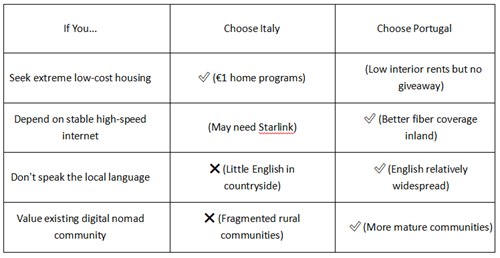
5.3 Quick Selection Guide: Rural Remote Work Edition
6.Decision Framework: 5 Questions to Help You Choose
Let's conclude with a practical decision matrix to assist your final judgment:
6.1 Quick Decision Matrix
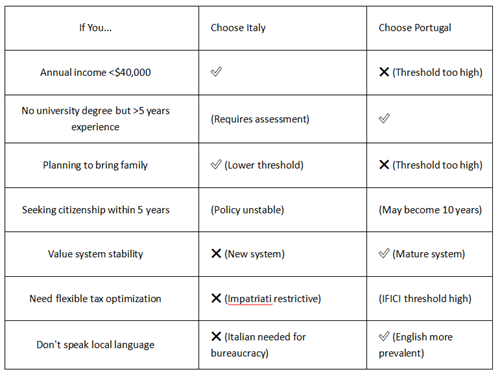
6.2 Application Timeline Planning Recommendations
Italian Route (Prepare 6 months in advance):
T-6 months: Begin translation and authentication of education/work documentation; explore accommodation options
T-4 months: Schedule consulate interview (note fingerprinting requirement since 2025; appointment slots tight)
T-3 months: Sign accommodation contract or arrange Airbnb long-stay; purchase health insurance covering €0,000+
T-2 months: Submit visa application
T-0: Apply for residence permit (permesso di soggiorno) within 8 days of entry
Portuguese Route (Prepare 4 months in advance):
T-4 months: Apply for NIF (Portuguese tax number); open Portuguese bank account
T-3 months: Prepare proof of income (last 3 months), savings proof, accommodation proof
T-2 months: Submit visa application
T-0: Book AIMA appointment for residence card conversion after entry (note appointments may be months out)
FAQ
Q1: Can the Italian Digital Nomad Visa be converted to a self-employment work visa?
Currently, Italian law does not explicitly allow conversion of a digital nomad residence permit to another type of residence permit. However, after 5 years, eligible individuals may apply for an EU long-term residence permit.
Q2: Does the Portugal D8 Visa allow working for Portuguese companies?
Limited work for Portuguese clients is permitted, but the majority of income (typically understood as >50%) must come from non-Portuguese entities. If your primary income source shifts to Portugal, visa renewal may be affected.
Q3: Is there an official occupation list for Italy's "highly skilled" designation?
There is no official occupation list. For the ICT sector (ISCO-08 categories 133/25), 3 years of work experience is sufficient; other fields require 5 years' experience or a 3-year university degree. Higher approval rates are observed in IT, engineering, design, and consulting fields.
Q4: If Portugal's nationality law reform takes effect, will existing D8 visa holders be affected?
Currently uncertain. The Constitutional Court has struck down some provisions; the final law is not yet in effect. Typically "grandfather clauses" protect existing applications, but it is advisable to submit applications before the law is finalized to minimize risk.
Q5: Do both countries recognize same-sex partners for family reunification?
Portugal recognizes stable unions (união estável); same-sex partners may apply for family reunification. Italy recognizes civil unions, but administrative procedures are more complex; certified relationship documentation must be provided at the time of application.
Q6: Can I work remotely while my visa application is pending?
Both countries require applicants to submit applications from their country of residence. You may continue remote work during this period, but you may not work from a country other than your country of residence (i.e., you cannot work while in the target country on a tourist visa during the waiting period).
Author Credentials
Jonathan R. Whitfield, Esq.
Position: Immigration Law Practitioner, Cross-border Tax Strategy Consultant, Founding Partner of Remote Mobility Law Group
Professional Qualifications:
AILA Certified Member (American Immigration Lawyers Association), specializing in non-immigrant visa categories (since 2018)
Member of the International Law Committee of the New York State Bar Association
EC Immigration Law Certificate (European Immigration Law Certificate, 2021)
Non-resident Tax Litigation Qualification of the U.S. Tax Court
Professional Areas: Digital Nomad Visa Architecture Design, U.S.-EU Cross-border Tax Compliance, Southern Europe Residence Strategy Planning
Academic Background:
J.D., Georgetown University Law Center (International Law Direction)
LL.M. (Tax Law), New York University School of Law
B.A., University of California, Berkeley (Political Science and International Relations)
Practice Information:
Practice State: New York State (NY Bar # 5128476), California State (CA Bar # 325614)
Law Firm Address: Remote Mobility Law Group, 350 Fifth Avenue, Suite 7600, New York, NY 10118
Consultation Phone: +1 (212) 555-0147 (Monday to Friday, 9:00-18:00, Eastern Time)
Professional Email: [email protected]
LinkedIn: linkedin.com/in/jonathanrwhitfield-esq
Appointment Consultation: calendly.com/jwhitfield-esq-initial-consult
Conflict of Interest Statement: The author and the law firm have no commercial relationship or referral fee arrangement with any immigration agencies, real estate investment institutions, or visa service platforms. This article is independently written based on public policy documents, official statistics, and immigration case studies, and has not received any government or commercial institution funding.
References
[1] Studio BCZ. (2026, March 25). Italy‘s Digital Nomad Visa: Legal, Tax and Social Security Framework. https://www.studiobcz.it/en/italys-digital-nomad-visa-legal-tax-and-social-security-framework/
[2] Italian Citizenship Assistance. (2026, February 4). Digital Nomad Visa. https://italiancitizenshipassistance.com/digital-nomad-visa/
[3] Remote Work Europe. (2026, February 21). Portugal D8 Digital Nomad Visa: The 2026 Mistakes That Get You Rejected. https://remoteworkeurope.eu/insights/portugal-d8-visa-mistakes-2026/
[4] The Golden Portugal. (2026, January 9). Portugal D8 Digital Nomad Visa 2026. https://www.thegoldenportugal.com/portugal-d8-visa/
[5] Xinhua News Agency. (2026, April 2). Portuguese parliament approves revised nationality law, tightening citizenship rules. http://www.china.org.cn/world/Off_the_Wire/2026-04/02/content_118415664.shtml
[6] IMI Daily. (2026, April 9). Portugal’s New Nationality Law: A Missed Opportunity for Early Genuine Integration. https://www.imidaily.com/opinion/portugals-new-nationality-law-a-missed-opportunity-for-early-genuine-integration/
Disclaimer
The content of this article is based on publicly available information and policy documents as of April 13, 2026. Immigration laws are time-sensitive and jurisdiction-specific; policies may change without notice. This article does not constitute legal advice. Readers should consult a licensed immigration attorney or relevant government authorities before making immigration decisions. The author assumes no liability for any direct or indirect losses arising from the use of information contained herein.
Transparency Statement
Data Sources: Data in this article are derived from official immigration agency documents, AIMA annual reports, OECD cost-of-living databases, and actual case sharing from immigration lawyer communities.
Update Mechanism: This article will be updated quarterly, with immediate revisions for significant policy changes. Last updated: April 13, 2026.
Potential Biases: The author writes primarily from the perspective of U.S. applicants; non-EU applicants may face different requirements. Additionally, Italian visa data are relatively limited; some conclusions are based on immigration lawyer estimates rather than official statistics.
Unresolved Controversies: The final provisions of Portugal's nationality law reform remain undetermined; Italy's "digital nomad tax bonus" is still under legislative discussion with specific details unclear.
Recommended for you