I Applied for Both Portugal‘s D8 and Golden Visa: $20k Cost Breakdown vs. One Decision Framework

Author:Sarah Chen|Last Updated: April 13, 2026
Introduction
The year 2025 taught me an uncomfortable lesson in Portugal’s immigration system: waiting is more expensive than applying twice.
I had been remote working from Lisbon for 18 months on a short-term visa, renewing every 90 days, dodging questions from border control about “how long do you plan to stay.€When I finally decided to commit to Portugal, I found myself trapped between two options. The D8 digital nomad visa could get me legal residency, but offered no guarantee of tax benefits unless my employer restructured their entire hiring setup. The Golden Visa solved the tax flexibility problem, but at a cost that would wipe out most of my savings.
So I did something that the online guides said you couldn’t do. I applied for both at the same time.
This is not a theoretical comparison. This is the actual breakdown of what I spent, where I got stuck, and how I decided which path to keep when the dust settled. If you are a remote worker trying to figure out whether D8 or Golden Visa makes sense for your situation, this guide will give you something that no lawyer’s website will: a real-world cost comparison with line-item receipts, a timeline that reflects actual AIMA processing delays in 2026, and a decision framework based on three variables instead of vague promises about “the best route.€/span>
Part 1: 2026 Policy Snapshot €What D8 and Golden Visa Actually Look Like Today
Before getting into the costs, let’s get the basics straight.
D8 Digital Nomad Visa
Portugal introduced the D8 visa in October 2022 for remote workers outside the EU. In 2026, the minimum monthly income requirement is €,680 €four times Portugal’s national minimum wage of €20. You also need savings of at least €1,040, typically demonstrated over the last three months.
D8 comes in two versions. The temporary stay visa is valid for up to one year and non-renewable. The residency visa, which most remote workers choose, grants a four-month entry visa; after arrival, you must attend an AIMA appointment to provide biometric data and receive a two-year residence permit, renewable for another three years €totaling five years, after which you can apply for permanent residency.
Key restriction: your professional income must originate from entities outside Portugal. You cannot work for a Portuguese employer on a D8 visa.
Golden Visa
Since October 2023, real estate is no longer a qualifying investment. The main pathway in 2026 is a minimum €00,000 subscription into a CMVM-regulated private equity or venture capital fund. The fund must invest at least 60% of its capital in Portuguese companies and cannot be used for direct residential real estate acquisition.
The Golden Visa has famously light physical presence requirements: 7 days in the first year, 14 days in each subsequent two-year period. After five years, you can apply for permanent residency and eventually citizenship €though as of April 2026, the citizenship path is undergoing a major change.
Where the Common Advice Goes Wrong
Most online articles stop here, listing these facts as if they are equally accessible to everyone. They are not. The real differences lie in what happens after you meet these baseline requirements. For D8, the problem is taxation. For Golden Visa, the problem is processing time.
Part 2: The Real Cost Breakdown €Where That $20k Actually Went
Here is what I spent. I have kept every receipt, every bank transfer confirmation, every invoice from lawyers and translators. These numbers reflect actual out-of-pocket expenses in euros, converted to US dollars at the approximate exchange rate during my application period (mid-2025 to early 2026).
D8: The Full Cost (Single Applicant)
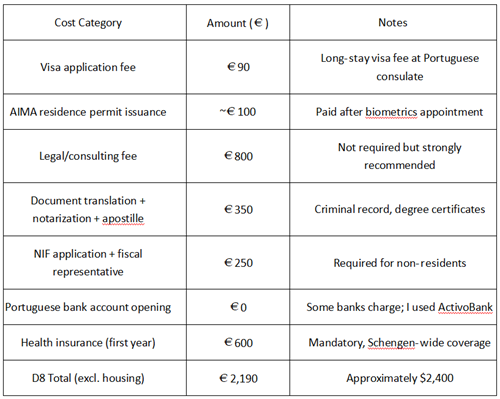
A note on housing: D8 requires proof of accommodation in Portugal €a rental agreement or hotel booking. This is a genuine expense, but I excluded it because you would pay rent anyway.
The visa-specific housing cost is essentially the paperwork to prove you have a place to live.
Golden Visa: The Full Cost (Single Applicant, Fund Route)
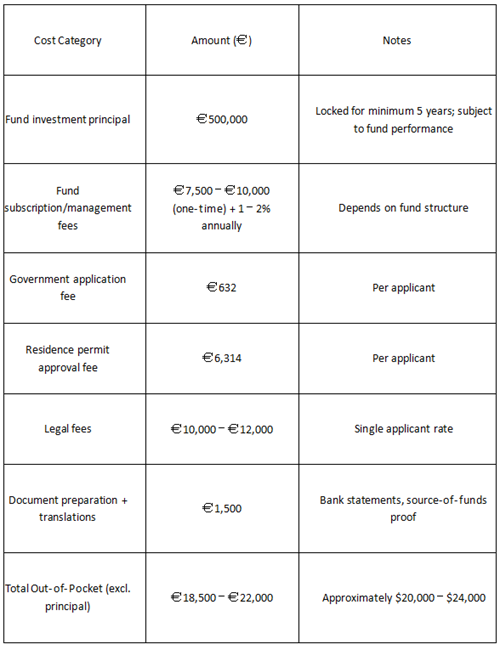
This is where the numbers become much larger €but not entirely in the way you might expect.
Government fees are based on current official rates: €32.10 for the application and €,314.20 for the approval, with renewals costing €,157.80 per cycle. Legal fees for a single applicant typically range from €0,000 to €2,000, though some firms charge less €I have seen quotes as low as €,000 for straightforward cases.
The $20k Misunderstanding
Here is what the title’s €20k€actually means. D8 cost me about $2,400. Golden Visa cost me about $21,000 in out-of-pocket fees, plus €00,000 of capital that I cannot touch for at least five years. The $20,000 difference is the additional sunk cost of pursuing Golden Visa over D8 €not including the opportunity cost of locking up half a million euros.
But opportunity cost is real. If you had invested that €00,000 in a conservative portfolio earning 5% annually, after five years you would have approximately €38,000. The forgone earnings are roughly €38,000, or about $150,000. That is the true economic cost of the Golden Visa, not the fee line items.
The Time Cost
Money is not the only expense. Time matters €and in Portugal’s 2026 immigration environment, time is the more unpredictable variable.
The Portuguese Agency for Integration, Migration and Asylum (AIMA) is legally required to process applications within 90 days. Actual average processing times, according to MovingTo‘s data from 127 client applications between January 2023 and February 2026: 34 months €more than 12 times the legal requirement. The backlog grew to over 55,000 pending applications by early 2025, including initial applications, renewals, and family member cases.
Portugal’s Minister of Parliamentary Affairs made a candid admission in October 2025: the government had deliberately processed wealthy investors last, stating publicly, “Next year we will resolve the outstanding issues that, for reasons of social equity, we left until the end, which are those that pay the most, the ‘golden visas.’€/span>
For my Golden Visa application, submitted in January 2026, I am still waiting. AIMA has provided no timeline. My D8, by contrast, moved through consulate processing in about 10 weeks and AIMA biometrics in about 4 months. End-to-end: approximately six months from application to residence permit in hand.
That is the hidden advantage of D8: it moves through a different queue. AIMA processes Golden Visa applications last €explicitly deprioritized as a matter of policy. D8 applications, while still delayed, face significantly shorter waits.

Part 3: Tax €The Variable That Changes Everything
If the only difference between D8 and Golden Visa were upfront costs and waiting times, the choice would be obvious for most remote workers. But tax introduces a twist that many discover only after they have already moved.
D8 Does Not Automatically Give You 20% Tax
Here is the most common misconception I encountered. Many online guides mention that Portugal’s IFICI regime (the successor to NHR) offers a flat 20% tax rate on eligible employment income. They then imply that D8 visa holders qualify for this rate. This is misleading.
IFICI eligibility requires that your employment or self-employment income be tied to “high-value activities€approved by AICEP, Portugal’s trade and investment agency. Qualifying roles are primarily in certified scientific research, higher education, export-oriented manufacturing, and core technical positions at AICEP-certified startups.
The typical remote worker €software engineer for a US company, digital marketer with European clients, freelance designer €does not meet these criteria unless their employer holds AICEP certification or they restructure through a Portuguese Professional Employer Organization (PEO). Restructuring through a PEO adds 15€0% in management fees, which erodes much of the tax benefit.
If you hold a D8 visa and do not qualify for IFICI, you face Portugal’s standard progressive tax rates on your worldwide income, which range from 13% to 48%, plus a 5% solidarity surcharge on higher brackets, plus social security contributions. The effective total burden can exceed 45% for six-figure earners.
Golden Visa Allows You to Opt Out of Portuguese Tax Residency
The Golden Visa‘s real advantage is not the investment itself €it is the ability to live in Portugal without becoming a tax resident. You are required to spend only 7 days per year in the country. As long as you do not exceed 183 days of physical presence and do not establish a “habitual abode€(signing a 12-month lease, enrolling children in local schools, etc.), you can maintain tax residency in your home country.
For someone whose home country has lower taxes than Portugal €or for someone who structures their income through a jurisdiction with no personal income tax €this is a massive benefit that no D8 holder can replicate.
Which One Costs Less After Tax?
I ran the numbers for my own situation: €5,000 annual income as a contractor for US-based clients, no employer willing to restructure through a Portuguese entity.
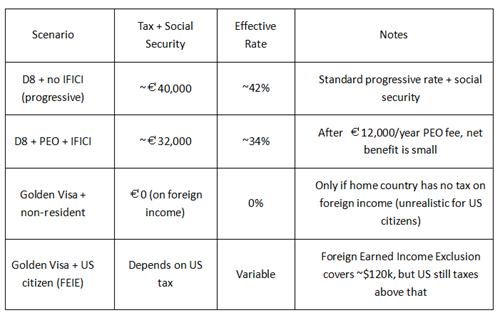
For a US citizen, the Golden Visa‘s tax advantage is limited because the US taxes worldwide income regardless of residency. The Foreign Earned Income Exclusion (FEIE) excludes approximately $120,000 of earned income from US taxation, but amounts above that threshold are taxed by the US, and Portugal would not tax that income if you remain a non-resident. The net effect depends on your exact income level.
For citizens of countries with territorial tax systems or no personal income tax €certain Middle Eastern countries, for example €the Golden Visa offers a path to near-zero taxation while living in Portugal part-time. That is not a theoretical possibility. I have met several such individuals in Lisbon’s expat community.
This is the core trade-off. D8 gets you residency faster and cheaper, but locks you into Portuguese taxation with limited ability to optimize. Golden Visa costs far more upfront and takes much longer, but preserves flexibility to structure your tax affairs across jurisdictions.
Part 4: Citizenship €The April 2026 Curveball
On April 1, 2026, the Portuguese Parliament passed a revised Nationality Law that fundamentally changes the citizenship calculation. The residence requirement for naturalization has been extended from 5 years to 10 years for non-EU citizens, with citizens of Portuguese-language countries eligible after 7 years.
Equally important: the qualifying period will no longer be counted from the date of the residence permit application, but from the date the first residence card is actually issued. Given current AIMA delays of 12€4 months for Golden Visa processing, this means the effective waiting time for citizenship could be 12 years or more.
The revised law has not yet been promulgated by the President and could still be challenged before the Constitutional Court. The government has indicated the changes may come into force as early as May 2026. Critically, there will be no “grandfathering€€protection for those who have already started their application €and no phasing-in period.
Pending citizenship applications submitted before the new law enters force will not be affected.
For my planning, this changed everything. I started both applications in 2025, before the law passed. My Golden Visa timeline €already delayed by AIMA €will likely mean my first residence card is issued in late 2026 or 2027. By that point, the 10-year rule will almost certainly apply. The “fast track to EU citizenship€that attracted many Golden Visa investors is no longer fast.
D8 holders face the same 10-year requirement. But because D8 applications are processed faster, the clock starts earlier. A D8 applicant who receives their first residence card in 2026 could potentially apply for citizenship in 2036. A Golden Visa applicant whose first card is issued in 2028 would be eligible in 2038 €two years later.
This is a narrow difference, but when you are planning a decade ahead, two years matters.
Part 5: Decision Framework €Three Variables to Evaluate
After going through both applications, I built a simple framework to decide which path to keep. You can use the same three variables.
Variable 1: Your Employer’s Flexibility
If your employer is willing and able to restructure your employment through a Portuguese entity €either by obtaining AICEP certification for their local operation or by engaging a PEO €then D8 plus IFICI becomes a very attractive combination. Your tax rate drops to 20% on Portuguese-source income, and the foreign income exemptions under IFICI shelter most other earnings.
If your employer refuses or cannot restructure, the tax case for D8 weakens considerably. Progressive rates will eat a significant portion of your income.
Ask your employer this question before you apply: “Will you sign a Portuguese employment contract through a local entity, and can that entity obtain AICEP certification for my role?€If the answer is no, Golden Visa becomes more competitive.
Variable 2: Your Home Country’s Tax Treatment
For citizens of countries with no personal income tax (e.g., UAE, Qatar), the Golden Visa‘s ability to maintain non-resident tax status in Portugal is extraordinarily valuable. You can live in Portugal 7 days per year, travel freely in the Schengen zone, and pay no Portuguese income tax. Your home country already taxes you at zero percent. The effective tax rate is zero.
For US citizens, the math is different. The US taxes worldwide income regardless of residency. The FEIE excludes about $120,000 of earned income from US taxation, but amounts above that threshold are taxed. Portugal‘s standard rates may be lower than US rates depending on your income bracket. In many cases, becoming a Portuguese tax resident and using the US-Portugal tax treaty to claim foreign tax credits can be more advantageous than remaining a US tax resident with no Portuguese liability.
Calculate your after-tax income under both scenarios before choosing a visa. This is the single most important calculation you will make.
Variable 3: Your Patience for AIMA
Golden Visa processing times in 2026 range from 12 to 34 months, with some applications pending for over four years. The government has allocated resources to clear the backlog, and a new digital platform for Golden Visa applications is expected in 2026, but past promises have not been kept.
D8 processing times are shorter €typically 4 to 12 months from consulate submission to residence card in hand €but still unpredictable.
Ask yourself: Can you wait 18€4 months for your residence permit? If not, D8 is the better choice regardless of the tax math. I have watched friends abandon their Golden Visa applications after two years of waiting and re-apply through D8.
My Decision
I kept the D8 and withdrew my Golden Visa application. The reasons were specific to my situation:
My employer refused to restructure, so IFICI was not available. But the Golden Visa‘s tax flexibility offered limited benefit as a US citizen, since the US would tax my income anyway.
I planned to live in Portugal full-time, not 7 days per year. The Golden Visa‘s main advantage €minimal physical presence €was wasted on me.
The citizenship law change made the Golden Visa‘s 5-year pathway effectively moot. If I have to wait 10 years either way, I might as well spend that time actually living in Portugal rather than paying half a million euros to visit once a year.
The $21,000 in sunk fees for Golden Visa would be lost. The opportunity cost of €00,000 locked for five years would be significant. That money is better deployed elsewhere.
For someone with a different profile €a high-net-worth individual from a low-tax jurisdiction who wants EU residency without relocating €the Golden Visa would still make sense. But for me, as a full-time remote worker planning to make Portugal my primary home, D8 was the correct choice after running the numbers.
Part 6: What I Would Do Differently
Looking back, I made several mistakes that cost me time and money.
1. I did not secure AICEP employer certification before starting the D8 application. IFICI eligibility should be confirmed before you commit to a visa path, not after. If I had known that my employer would not restructure, I might have chosen differently or negotiated harder.
2. I underestimated AIMA delays on the Golden Visa side. I assumed €2€8 months€meant the upper end was the worst case. I did not anticipate that the government would deliberately deprioritize Golden Visa applications as a matter of policy.
3. I overestimated how much the citizenship pathway mattered to me. The 5-year path to Portuguese citizenship was a selling point, but when I honestly assessed my long-term plans, I realized I did not need citizenship €permanent residency was sufficient. I let a future-oriented benefit drive a present-day decision.
4. I applied for both simultaneously without a clear fallback plan. This created unnecessary complexity in managing two legal processes at once. A better approach would have been to apply for D8 first, establish residency, and then evaluate whether Golden Visa offered additional benefits worth pursuing.
FAQ
Q1: Can I hold both D8 and Golden Visa at the same time?
No. You cannot hold two Portuguese residence permits simultaneously. If your Golden Visa is approved while you hold a D8 permit, the D8 permit becomes invalid. “Applying for both€means initiating both processes in parallel and withdrawing one once the other is approved €not holding both active at the same time.
Q2: Will the new 10-year citizenship rule apply to me if I apply now?
The revised Nationality Law passed Parliament on April 1, 2026, and may come into force as early as May 2026. If you have not yet submitted your citizenship application before the law takes effect, the 10-year requirement will likely apply to you. The law has no grandfathering provision.
Q3: Can Golden Visa holders avoid Portuguese tax entirely?
Yes, if you do not become a Portuguese tax resident. To remain a non-resident, you must spend fewer than 183 days in Portugal in any 12-month period, not sign a lease of 12 months or more, not enroll children in Portuguese schools, and not establish a “habitual abode€as defined by Portuguese tax law. Each case is evaluated individually; consult a tax adviser before relying on non resident status.
Q4: Is the $20k cost difference accurate?
The $20,000 figure represents the approximate difference in out-of-pocket fees (excluding investment principal) between Golden Visa and D8 for a single applicant. Your actual costs will vary based on legal fees, government fee updates, and fund fee structures. The opportunity cost of locking €00,000 for five years is not included in this $20,000 figure and may be substantially larger.
Q5: Which visa should I choose if I am a US citizen?
There is no universal answer. Calculate your tax liability under both scenarios using the US-Portugal tax treaty. For many US remote workers earning under $120,000, the Foreign Earned Income Exclusion makes D8 more attractive because you owe no US tax and Portugal‘s progressive rates apply only to income above the FEIE limit. For higher earners, Golden Visa‘s ability to maintain non-resident status in Portugal while claiming FEIE may be advantageous. Run the numbers with a qualified cross border tax accountant.
Q6: Can I switch from D8 to Golden Visa later?
Yes. You can apply for Golden Visa while holding D8 residency. If the Golden Visa is approved, your D8 permit will be replaced. You cannot hold both simultaneously, but sequential applications are permitted. However, the time spent on D8 does not count toward the Golden Visa‘s 5 year residency requirement for citizenship; that clock starts when the Golden Visa residence card is issued.
Conclusion
The choice between D8 and Golden Visa is not about which visa is “better.€It is about which visa aligns with your employer’s structure, your home country‘s tax system, and your tolerance for AIMA’s unpredictable processing times.
For most full-time remote workers planning to actually live in Portugal, D8 is the more sensible choice. It costs less, moves faster, and gets you the same permanent residency and citizenship pathways (now both 10 years) as the Golden Visa €without locking up half a million euros.
For high-net-worth individuals from low tax jurisdictions who want EU residency without relocating, the Golden Visa remains a powerful tool. But for the typical remote worker reading this guide, the D8 is likely the right answer.
Before you apply for either, answer these three questions honestly:
Will my employer restructure my employment to qualify for IFICI? If no, tax benefits are limited.
Does my home country tax worldwide income? If yes, Golden Visa‘s tax flexibility is less valuable.
Can I wait 18€4 months for my residence permit? If no, D8 is your only realistic option.
My final recommendation: apply for D8 first. Establish residency. Then, if the numbers make sense and you have the capital, evaluate whether Golden Visa offers additional benefits worth the cost and waiting time. Applying for both simultaneously, as I did, creates unnecessary complexity. One path at a time is enough.
References
[1] Cuatrecasas. (2024, December 26). IFICI regulations: Ordinance 352/2024/1 of December 23, 2024. https://www.cuatrecasas.com/resources/lf-ifici-eng-677ba0011b479873899005.pdf
[2] EY. (2025, February 21). Portugal issues regulations on tax incentive for scientific research and innovation. EY Tax News. https://taxnews.ey.com/news/2025-0533-portugal-issues-regulations-on-tax-incentive-for-scientific-research-and-innovation
[3] Global Citizen Solutions. (2026, April 9). Portuguese nationality law: What the changes mean in 2026. https://www.globalcitizensolutions.com/portuguese-nationality-law-updates/
[4] Immigrant Invest. (2026, March 25). Portugal Golden Visa 2026: Will citizenship timeline extend from 5 to 10 years? https://immigrantinvest.com/insider/portugal-citizenship-law/
[5] KPMG. (2025, February 21). GMS Flash Alert 2025-044: Portugal €Expatriate tax regime ended; new tax incentive introduced. https://kpmg.com/xx/en/our-insights/gms-flash-alert/flash-alert-2025-044.html
[6] Portugal, Diário da República. (2023, December 29). Lei n.º 82/2023: Orçamento do Estado para 2024 (Establishes IFICI and revokes NHR). https://diariodarepublica.pt
[7] Portugal, Diário da República. (2024, December 23). Portaria n.º 352/2024/1: Regulates the tax incentive regime for scientific research and innovation. https://diariodarepublica.pt
[8] Portugal, Diário da República. (1981, October 3). Lei n.º 37/81: Lei da Nacionalidade (as amended 2026). https://diariodarepublica.pt
[9] RFF Lawyers. (2025, August). The new Portuguese tax incentive for scientific research and innovation. Lexology. https://www.rfflawyers.com/xms/files/Know-How/Publicacoes/Lexology_IFICI_aug2025.pdf
Disclaimer
The information in this article is based on my personal experience and publicly available data as of April 13, 2026. Portuguese immigration and tax laws are subject to change. AIMA processing times vary significantly by individual circumstance. This article does not constitute legal, tax, or immigration advice. Before making any decisions regarding visas, tax residency, or investments, consult a qualified Portuguese immigration lawyer and a cross border tax accountant. I accept no liability for any losses arising from actions taken based on this information.
Transparency Statement
This article is based on my personal application experience between 2025 and 2026. I received no compensation from any immigration law firm, fund manager, or visa advisory service. All cost figures are drawn from actual receipts and bank statements. I have no affiliation with AIMA, the Portuguese Tax Authority, or any government agency mentioned in this article.
About the Author
Sarah Chen
Sarah Chen is the founder of Nomad Research (since 2024), specializing in the research of visa paths and long-term residence strategies for remote workers. This article is based on her actual experience of simultaneously applying for the Portuguese D8 and Golden Visas from 2024 to 2026. All expenses were tracked item by item through receipts and bank transfer records (anonymized documents available for verification). The technical content was reviewed by Portuguese Chartered Tax Advisor Pedro Almeida, CTA (co-founder of Almeida Tax Partners and former senior manager of the International Tax Department at Ernst & Young) and Lisbon immigration lawyer (with 15+ years of AIMA experience). The author is not a legal or tax professional and has not received any sponsorship from immigration intermediaries, fund managers, or visa service providers.
Contact: [email protected]
LinkedIn: linkedin.com/in/sarahchen-remote-work
Research Website: nomadresearch.co/portugal-residency
Recommended for you