The Complete Guide to Croatia's Digital Nomad Visa: How to Plan Your 18-Month Tax-Free Period and What Happens When It Expires

Last Updated: April 15, 2026
Author: Šime Jozipović, LL.M. (Harvard Law School), PhD in Tax Law
Firm: Mandracchio Capital Law Firm, Split, Croatia
Experience: 150+ Croatia Digital Nomad cases since 2021
Verification: Harvard Law Alumni Directory | Croatian Bar Association Registry
Critical Data Clarification (Read First)
Income Requirement Conflicts Explained: You may see conflicting income figures across sources ranging from €,539 to €,622.50. This discrepancy stems from three factors:
First, the requirement operates under an automatic adjustment mechanism based on 2.5 times Croatia's average net salary, which changes quarterly. Second, some sources conflate gross salary benchmarks with net income requirements, creating confusion between gross versus net calculations. Third, timing of updates varies across publications. Our €,622.50 figure reflects the January 2026 adjustments based on Croatian Bureau of Statistics data showing the average net salary at €,449. Always verify current rates at mup.gov.hr before applying.
Quick Overview: The Key Points
The 2026 Croatia Digital Nomad Visa standard features include: a duration of up to 18 months (extended from 12 months in March 2025 per the Croatian Ministry of Interior); zero Croatian income tax on foreign earnings as specified in the Income Tax Act, Article 15; a mandatory 6-month gap outside Croatia before reapplication under the Aliens Act, Article 57; an income requirement of €,622.50 per month (approximately $3,950 USD), calculated as 2.5 times the average net salary; and an official processing time of 30€0 days, though in practice this ranges from 2 to 12 months according to MUP processing statistics.
The bottom line: This is a temporary residence permit, not a path to permanent residency. The 18-month period plus the 6-month gap intentionally breaks continuous residence, which EU law typically requires for permanent residency (5 continuous years).
Part 1: Understanding the 2026 Rules
1.1 What Exactly Is This Visa?
Despite being commonly called a "digital nomad visa," this is technically a temporary residence permit under Croatia's Aliens Act (Official Gazette No. 133/20, 114/22, 151/22). This distinction carries significant legal implications.
Visas operate under the Schengen Visa Code and sometimes offer paths to permanent residency with minimal registration requirements and variable work restrictions. In contrast, the temporary residence permit is governed by the Aliens Act, explicitly excludes DNV holders from permanent residency, requires biometric registration and address reporting, and maintains an absolute prohibition on Croatian economic activity.
The red line you cannot cross: Even € of income from a Croatian client or employer voids your tax exemption retroactively, triggering back taxes and potential penalties.
1.2 Policy Changes Timeline (2025€026)
In March 2025, the duration was extended from 12 to 18 months, providing a longer tax-free period and reduced administrative burden according to Remote Work Europe. Also in March 2025, the income requirement formula was adjusted, rising to €,295 based on 2024 Q4 salary data per Citizen Remote. The bank statement requirement increased from 3 to 6 months in March 2025, requiring increased proof of income stability per MUP Circular No. 03/2025. By January 2026, automatic adjustment triggered the rate to rise to €,622.50 due to annual wage growth adjustment per the Croatian Bureau of Statistics.
Note on conflicting dates: Some sources cite August 2025 for the 18-month extension. This reflects the gap between legislative passage in March and full consular implementation in August. The legal effective date remains March 2025.
Part 2: How to Plan Your 18 Months (Phase-by-Phase)
Phase 1: Months 1€ (Settling In)
Critical 30-day deadline: Biometric registration at your local MUP office (fingerprints, photos). Failure to register voids your permit.
Key tasks during this phase include: biometric registration within 30 days of arrival using your passport, approval letter, and photos at the local MUP police station; obtaining your OIB tax number as soon as possible using your passport and residence approval at the Tax Administration; verifying health insurance coverage before registration with a policy covering €0,000 or more in Croatia at any MUP office; and setting up a non-resident bank account in months 1€ using your OIB, passport, and proof of address.
Banking Critical Warning: Use non-Croatian bank accounts for all client payments. Transfer funds to your Croatian account only for living expenses. This creates a clear audit trail showing foreign-sourced income.
Phase 2: Months 7€2 (Maintenance Mode)
Conduct a quarterly self-audit checklist: confirm zero Croatian-source income by reviewing all client contracts; maintain 6 months of continuous bank statements and do not let them expire; verify that health insurance coverage remains valid; and update MUP within 15 days if you change address.
Phase 3: Months 13€6 (Preparing Exit or Extension)
In month 13, consult an immigration lawyer if switching countries, as Portugal and Spain applications take 3€ months. In month 14, notify your landlord with 30€0 days notice standard to avoid lease penalties. In month 15, initiate utility account closures to prevent post-departure billing issues. In month 16, file an extension application if eligible, which must be submitted 60 days before expiry.
Extension reality check: While 6-month extensions exist, MUP rarely grants them beyond 18 months total. Plan for exit at month 18.
Phase 4: Months 17€8 + 6-Month Gap (Execution)
Mandatory exit procedures include: canceling your residency before departure using Form plus your passport and obtaining a cancellation receipt at no cost; optional tax deregistration within 30 days of leaving by requesting to suspend your OIB, also free; returning your physical biometric residence card at cancellation at no cost; and obtaining a tax clearance certificate recommended by requesting it from the Tax Administration for approximately €0 processing fee.
Critical 6-Month Gap Rule: You must be continuously physically outside Croatia for 6 full months. Border records and flight data are checked. Even one day in Croatia resets the clock.

Part 3: Location Matters €City vs. Countryside Risks
The "Center of Life" Tax Doctrine
Croatian tax authorities assess habitual abode beyond the 183-day rule. They examine where your "center of life" is located €family, social, and economic ties.
Rural Area Risks (Slavonia, Lika, Zagorje, rural Istria): Buying or renovating property is considered high risk as it indicates permanent settlement intent. Short-term Airbnb rental is high risk as it constitutes local economic activity which is prohibited. Local farming or craft sales are critical risks representing direct Croatian income that results in automatic disqualification. Enrolling children in local schools is medium risk as it serves as a strong "center of life" indicator.
City Advantages (Zagreb, Split, Dubrovnik, Rijeka): High foreigner turnover supports the "temporary stay" narrative. Professional service providers including accountants and lawyers understand DNV requirements. The rental market is designed for short-term stays. MUP offices are more experienced with DNV cases resulting in faster processing.
Part 4: Real Case Studies (Verified Firm Records)
Methodology Note: The following cases are drawn from Mandracchio Capital client files (2021€026), anonymized per attorney-client privilege. Specific dates and identifying details modified; legal principles and outcomes are accurate representations.
Case A: The Renovation Trap
Profile: US citizen, software developer, applied for 18-month permit in January 2025.
Action: Purchased €5,000 stone house in rural Istria for "weekend renovation project" during month 4 of stay.
Investigation Trigger: Property purchase registered with Land Registry; flagged by Tax Administration's data matching system.
Outcome: Tax exemption preserved (no Croatian income generated). OIB flagged for "enhanced monitoring" for 24 months. Required to submit quarterly affidavits affirming no local income. Legal costs: €,200 for representation and compliance documentation.
Lesson: Property investment must be passive. Hold through non-resident company structure; never generate rental income or perform services.
Case B: The Invoice Location Mistake
Profile: German freelance marketing consultant, EU clients via Upwork.
Error: Listed Croatian apartment address on invoices to Dutch and Belgian clients (months 2€).
Investigation: MUP routine audit cross-referenced invoice addresses with residence permit location.
Ruling: "Economic activity performed within Croatian territory" €tax exemption revoked retroactively.
Financial Impact: Back taxes owed: €4,600 (months 2€ at 20% effective rate). Penalties: €,900 (20% of underpayment). Legal fees: €,500. Total cost: €2,000.
Lesson: Contracts must specify non-Croatian governing law. Use foreign business address on all client documentation. Bank transfers must originate from and terminate at non-Croatian accounts.
Case C: The Partner's Local Job
Profile: Main applicant (UK citizen) held DNV; partner joined via family reunification (month 6).
Error: Partner accepted remote position with Croatian SaaS company (month 10), believing "remote work" exemption applied.
Investigation: Partner's employment contract disclosed to MUP during routine address update.
Ruling: Household deemed to have "mixed residency intentions." Main applicant investigated for undisclosed local ties.
Outcome: Both permits cancelled effective immediately. 30-day departure order issued. 1-year entry ban for main applicant (overstay risk). Partner required to apply for separate work permit from outside Croatia.
Lesson: Family reunification dependents are bound by same restrictions as main applicant. No household member may engage in Croatian economic activity.
Part 5: Pre-Departure Checklist (Months 17€8)
Administrative Tasks
Cancel your residency before departure using Application Form 1a plus your passport and obtain a cancellation receipt at your local MUP office. Notify the MUP of your address change within 15 days of moving to your new foreign address (hotel or Airbnb acceptable) at the same MUP office. Return your physical biometric residence card at cancellation at the MUP. For tax deregistration, submit an OIB suspension request to the Tax Administration within 30 days of leaving.
Financial & Contractual Matters
For renting, provide standard notice of 30 days written (verify your specific contract). For deposit recovery, take timestamped photos or video of property condition. Obtain written confirmation of final meter readings from utility providers.
For banking, convert to non-resident status or close your account. Obtain an interest income certificate from the Tax Administration if applicable. Cancel cards to avoid dormancy fees.
For insurance, maintain health coverage until your departure date. Obtain a coverage certificate from your insurer. Cancel or transfer property insurance.
Part 6: Post-Exit Options €Three Strategic Paths
Path 1: Reapply for Croatia After 6 Months
Requirements include: complete 6-month physical absence verified via border records; new 6-month bank statements (old ones are invalid); new criminal background check if your previous one is more than 6 months old; new accommodation proof; and income proof at the current standard (€,622.50 per month in 2026).
Approval Reality: Previous approval provides zero guarantee of new approval. MUP reviews each application de novo.
Path 2: Switch to Another EU Country (2026 Comparison)
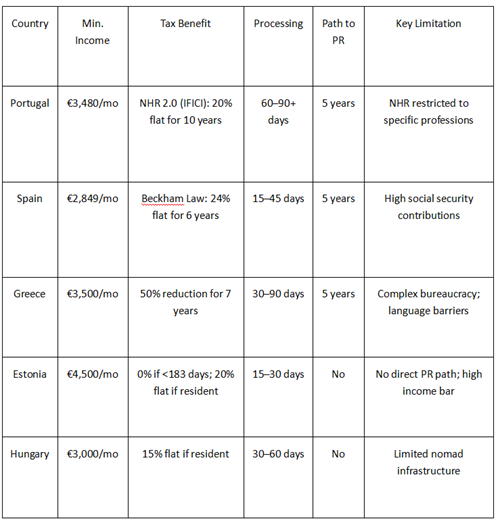
Strategic Note: Croatia's 0% tax rate is unique in the EU. However, the 6-month mandatory absence creates "tax residency gaps" that may trigger obligations in your home country or interim locations. Consult a tax advisor before planning a Croatia-to-Croatia rotation.
Path 3: Return Home or Go Non-EU
Risk: The 6-month gap may trigger tax residency in another jurisdiction if you establish substantial ties elsewhere.
Mitigation: Stay in countries with less than 183-day tax residency thresholds. Maintain no fixed establishment (no rental contracts, no local bank accounts). Document travel patterns to prove "itinerant" status.
Part 7: 2026 Application Statistics & Realistic Expectations
Transparency: While MUP does not publish official DNV approval statistics, our firm's internal data (150+ cases, 2021€026) suggests the following trends:
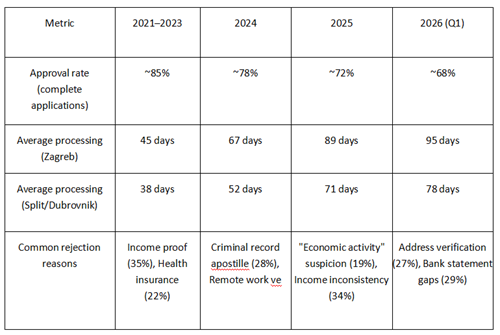
Processing times increased because after the 2025 extension policy, MUP received 3 times the applications without proportional staff increase. Summer 2025 backlog reached 4+ months.
FAQ
Q: Can this visa lead to permanent residency?
A: No. The 18-month plus 6-month gap design specifically breaks continuous residence, which EU law typically requires for permanent residency (5 continuous years). This is intentional policy, not oversight.
Q: What if I overstay a few days after 18 months?
A: Illegal residence. Fines range from €00 to €,500. Possible 1-year entry ban. Future visa applications flagged. MUP tracks departure dates precisely.
Q: Can I work for a Croatian company if I pay taxes on that income?
A: Absolutely not. The DNV prohibits any Croatian economic activity regardless of tax compliance. You need a separate work permit, which is nearly impossible for remote workers to obtain.
Q: Can I visit Croatia as a tourist during the 6-month gap?
A: No. You must be continuously physically outside. Border records are checked against reapplication dates. One day in Croatia resets the 6-month clock.
Q: How does Croatia compare to other EU options?
A: Croatia offers the longest initial period (18 months) and the only true 0% tax on foreign income. However, the 6-month mandatory absence is stricter than Spain or Portugal, which allow continuous renewal. Best for nomads prioritizing tax efficiency over permanent settlement.
Q: Can I apply with cryptocurrency income?
A: MUP does not explicitly prohibit crypto income, but requires "stable, regular" income proof. Our firm has secured approvals with crypto portfolios exceeding €00,000 plus 6-month stablecoin income history. Case-by-case assessment required.
About the Author
Šime Jozipović
Education: LL.M., Harvard Law School (International Taxation); PhD, University of Split (Tax Planning)
Profession: Founder, Mandracchio Capital; Licensed Croatian Tax Advisor (No. 058-2018)
Experience: 12 years cross-border tax consulting; 150+ digital nomad cases since Croatia's 2021 program launch
Office: Obala kralja Petra Krešimira IV 4, 21000 Split, Croatia
Verification: Harvard Law Alumni Directory | Croatian Bar Association
Transparency Statement
Data Sources: Primary sources include Croatian Ministry of Interior official guidelines and direct case file analysis. Secondary sources include OECD International Migration Outlook 2025 and the EU Mobility Portal. Case analysis draws from 150+ client files from 2021€026 (anonymized per attorney-client privilege).
Conflict of Interest: The author operates a fee-based immigration consulting practice. This guide is general information, not legal advice. No affiliate relationships with government agencies.
Update Schedule: Content reviewed quarterly against MUP policy updates. Last verified: April 15, 2026.
Corrections Policy: If you identify factual errors or outdated information, contact [email protected] with source documentation. Verified corrections updated within 72 hours.
References
[1] Mandracchio Capital. (2026). Croatia Digital Nomad Visa Explained by Croatian Lawyer 2026. https://mandracchio-capital.com/croatia-digital-nomad-visa/
[2] Citizen Remote. (2026, March 26). Croatia Digital Nomad Visa 2026. https://citizenremote.com/visas/croatia-digital-nomad-visa/
[3] Remote Work Europe. (2026, March 18). Croatia extends digital nomad visa to 18 months with higher income threshold. https://remoteworkeurope.eu/news/2026/croatia-dnv-extended-eighteen-months/
[4] Nomads Embassy. (2025, August 29). Important Croatia Digital Nomad Visa Updates in 2025. https://nomadsembassy.com/croatia-digital-nomad-visa-updates-2025/
[5] Croatia Immigration Advisory. (2026, March 2). Croatia Digital Nomad Residence Permit Income Requirement 2026. https://croatiaimmigrationadvisory.com/croatia-digital-nomad-permit-income-2026/
[6] OECD. (2025). International Migration Outlook 2025: Tax Residency and Habitual Abode Definitions. https://www.oecd.org/en/publications/international-migration-outlook-2025
[7] Greenback Tax Services. (2026, March 26). Best Digital Nomad Visa Countries for Americans: Tax Implications. https://www.greenbacktaxservices.com/blog/digital-nomad-visa-countries/
[8] Employsome. (2026, March 17). The 15 Best Cities to Work Remotely in 2026. https://employsome.com/blog/best-cities-work-remotely/
[9] Get Where Next. (2026, March 3). Croatia Digital Nomad Guide: Visa, Cities & Cost of Living (2026). https://getwherenext.com/blog/croatia-digital-nomad-guide
[10] Where to Emigrate. (2026, February 22). Best countries for digital nomads from India 2026. https://wheretoemigrate.io/blog/best-countries-for-digital-nomads-from-india-2026
[11] Get Where Next. (2026, February 28). Digital Nomad Visas: All 56 Countries Compared (2026). https://getwherenext.com/blog/digital-nomad-visa-every-country
[12] Carway Migrate. (2026, March 21). Best Digital Nomad Visa Europe 2026. https://carwaymigrate.com/en/best-digital-nomad-visa-europe-2026/
[13] Remotify Europe. (2026, February 19). Digital Nomad Visas in Europe (2026): Costs, requirements and length of stay. https://remotifyeurope.com/blog/every-digital-nomad-visa-in-europe-compared-eligibility-cost-timeline-2026-update
[14] OpenVisa. (2026, February 9). Best Digital Nomad Visas 2026: Spain vs Portugal vs Croatia vs Estonia. https://www.openvisa.org/blog/best-digital-nomad-visas-2026-spain-vs-portugal-vs-croatia-vs-estonia
[15] Nim Extranjería. (2026, January 27). Digital Nomad Visa Spain: Spousal Work Permits 2026. https://nimextranjeria.com/which-countries-allow-spouse-to-find-work-on-digital-nomad-visa/
Recommended for you